
Past Exhibits
Merry Christmas from Dr. Anna M. Gove
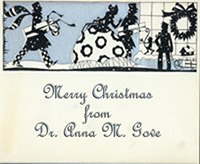
Anna Maria Gove was born July 6, 1867, in Whitefield, New Hampshire. After her education at MIT and Woman's Medical College of New York Infirmary, from which she graduated in 1892, Dr. Gove served for a year in the New York Infant Asylum. In 1893 she came to the State Normal and Industrial School (now UNCG). She remained at the school as resident physician, professor of hygiene, and director of the Department of Health until her retirement in 1937.
Fond of travel, Dr. Gove visited many parts of the world. In 1896-1897 and again in 1913-1914, she visited Vienna for postgraduate study. During WWI, she served with the Red Cross in the Children's Relief Division in Marseilles and Ardèche and with the Smith College Relief Unit. In 1926-1927 she took a leave of absence from the college and traveled extensively in the Orient. She also spent many summers in study and clinical work in the United States at Cornell, Chicago, New York and Michigan. Dr. Gove died in Greensboro on January 28, 1948.
Dr. Gove received numerous letters and cards from students, friends, and family. This exhibit features Christmas cards from the Dr. Anna Maria Gove Papers. For more information on the collection, please contact the Martha Blakeney Hodges Special Collections and University Archives (scua@uncg.edu or 334-5246), located in the Jackson Library.
Kay Brown, David O. Selznick, and Gone with the Wind
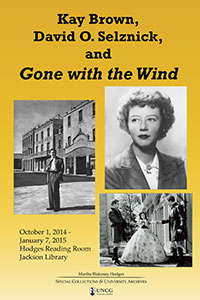
The Martha Blakeney Hodges Special Collections and University Archives is pleased to announce a new exhibit - Kay Brown, David O. Selznick, and Gone with the Wind. This exhibit features photographs and mementos from the life of Kay Brown, Eastern Representative of Selznick International Studios, including artifacts and costume lithographs from the movie Gone with the Wind.
In 1936, Kay Brown read the yet unpublished manuscript of Margaret Mitchell's Gone with the Wind and convinced producer David O. Selznick to buy the legal rights and produce the film. Gone with the Wind premiered in December of 1939 and became an instant critical and financial success. The movie swept the 1940 Academy Awards - nominated in thirteen categories and winning in eight.
After Selznick liquidated his studio in 1942, Brown became a talent scout and agent, representing stars such as Rex Harrison, Montgomery Clift, and John Gielgud, as well as writers Arthur Miller and Lillian Hellman. Brown was considered a brilliant and powerful presence in the literary and film industry until her retirement at 80. In addition to her career, she had a full personal life, marrying James Barrett and having two daughters, Laurinda and Kate. Dr. Kate Barrett is a Professor Emerita in the Department of Kinesiology of the School of Health and Human Sciences at UNCG and continues to be involved in many university projects.
This exhibit will be featured in the Hodges Reading Room from October 1, 2014 until January 7, 2015. The Reading Room is open from 9 a.m. until 5 p.m., Monday through Friday.
Lois Lenski: Art, Illustration, Literature, Research
Through May 31, 2014
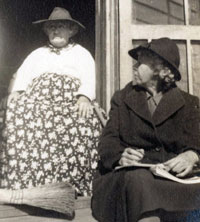
A thematic exhibit based on the Lois Lenski Papers and collections housed in The Martha Blakeney Hodges Special Collections and University Archives examines the work of Lois Lenski throughout her life. The exhibit is an attempt to show some aspects of Lenski's work that are familiar to many readers of her books, but also highlight other aspects that are not so well known. The exhibit uses artwork, research material made and collected by Lois herself, and interactive audio clips to provide context and expand our knowledge of her accomplishments.
Hazards to Books
Through January 15, 2014
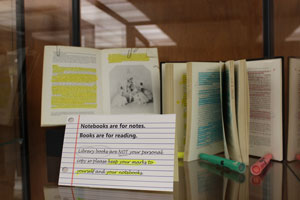
The Preservation Services division presents "Hazards to Books" in the first floor lobby cases of Jackson Library. With so many circulating books in our collections, it is inevitable that harm may come to some unfortunate few, as we showcase in this display. But there are simple steps our patrons can take to avoid damaging these vital resources:
1) If it is raining outside, ask for a plastic bag at the Check Out Desk in which to place your items and protect them from the wet weather.
2) Don't write notes or highlight passages in your library books. Instead, visit the Digital Media Commons
which offers free scanning. This is a wonderfully convenient way to scan documents and pages and either save them on a flash drive or, even easier, email them to yourself.
3) We love animals, but animals don't seem to have the same idea about our books. When the two are together, please place our library materials out of reach from your furry friends. It is astounding how quickly a dog can make mincemeat out of a library book.
Help us preserve our collections for generations to come!
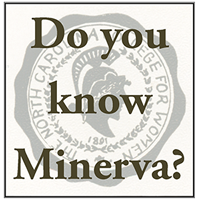
Do You Know Minerva?
Through November 30, 2013
An (interactive!) exhibit in the Elliott University Center connector highlights the origins, changes, and images of our goddess, Minerva. Learn about Minerva's classical background, how she may have come to be used on UNCG's seal, see many unique images of her, and discover the classical origin of one of the seal images.
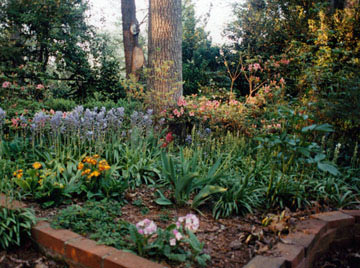
Gardening in Greensboro
April 15 - September 1, 2013
Greensboro has a number of garden clubs that work to keep the area beautiful and to encourage interest in gardening. These clubs have helped Greensboro Beautiful with the creation of the Greensboro Arboretum and the Bicentennial Park. They also hold events throughout the year, including workshops, flower arrangement displays, a home and garden tour, and a Christmas tree decorating contest.
Two such clubs-- the Sedgefield Garden Club (est. 1953) and the Tar Heel Garden Club (est. 1954)-- have donated their records, photographs, and scrapbooks to the Martha Blakeney Hodges Special Collections and University Archives. Materials from both collections make up this exhibit. The exhibit focuses on the volunteer work and flower arrangements that have made up the bulk of the clubs' activities.
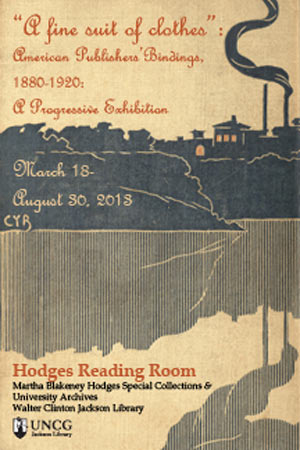
“A fine suit of clothes:” American Publishers’ Bindings, 1880-1920: A Progressive Exhibition
March 18 - August 30, 2013
Have you ever considered how artistic trends have influenced the design of book covers? Drawing on its extensive collection of American publisher bindings, Special Collections and University Archives has mounted an exhibit highlighting the “golden age” of book cover art before the advent of dust jackets. With the display of over a hundred covers, this exhibit reveals the strong and persistent influence of the Arts and Crafts movement and Art Nouveau. Along with offering a study of artistic and publishing trends in the late nineteenth century, the exhibit also encourages the rediscovery of a number of influential women designers such as Amy Sacker, Sarah Whitman, and Bertha Stuart.
Given the richness of the collection and the topic, the curators will be rotating content and introducing new topics and artists throughout the exhibit’s six month installation. This “progressive” exhibit approach offers the viewer the opportunity to return to discover new items and make new connections. In addition to the physical exhibit, the exhibit team also encourages people to access UNCG’s online digital collection of American Publishers’ Trade Bindings.
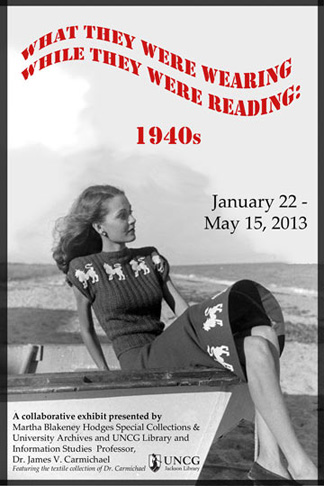
What They Were Wearing While They Were Reading: 1940s
January 22 - May 15, 2013
The events of the 1940s utterly transformed the foundations of American society. Impelled by World War II, the influx of immigrants fleeing Europe and the relocation of American soldiers to European and Asian war fronts led to the dissemination of new ideas, encouraged technological innovation, and altered traditional gender roles within American culture.
Forcing the United States from isolationism on to the world stage, WWII motivated the advancements of science and technology to support the war effort, both in terms of enhanced weaponry and modernized medicine. On the home front, the availability of automated home appliances liberated women to fill jobs previously only performed by men who had left to war, subsequently changing the overall structure of the American family.
With the return of service personnel at the end of the war, the repercussions of these changes were not fully understood. As the population began to recognize it could not restore its pre-war way of life, the conflict arising from the realization continued into the following decades.
This collaborative exhibit of clothing, artifacts, photographs, posters, and books is presented by Martha Blakeney Hodges Special Collections & University Archives and Dr. James V. Carmichael, Library and Information Studies Department, UNCG. The exhibit is housed across from the reference desk on the main level of Jackson Library.
Spartan Evolution: A History of Basketball on the UNCG Campus from the 1890s to Today
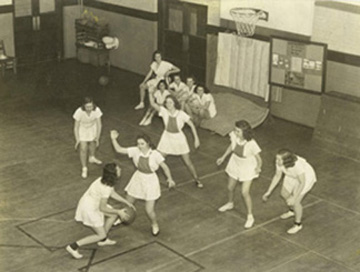
February 25, 2013 - April 15, 2013
From its founding in 1891 as the State Normal and Industrial School, the school now known as UNCG emphasized physical activity and personal health. A new exhibit from the Martha Blakeney Hodges Special Collections and University Archives explores the introduction and evolution of basketball on campus from the 1890s to today. Featuring images ranging from the women of the Athletic Association in 1900 to current head coaches Wes Miller and Wendy Palmer, this exhibit highlights key events and people in the development of intramural and intercollegiate basketball on campus.
The exhibit is housed next to the reference desk on the main level of Jackson Library. An online exhibit features additional information as well as a number of images used in the exhibit.
French History Illustrated: The Action Images of Job
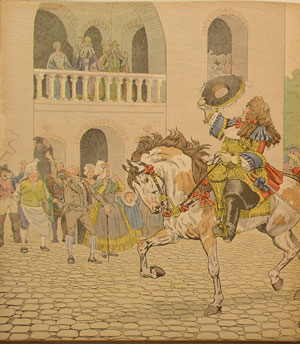
February 4, 2013 - March 14, 2013
The Martha Blakeney Hodges Special Collections & University Archives in Jackson Library is currently mounting a visiting exhibit of vibrant illustrations from late nineteenth- and early twentieth-century French books. “French History Illustrated: The Action Images of Job” represents the breathtakingly colorful book and magazine images of Jacques Onfroy de Breville (1858-1931), who was known by the pseudonym of “Job.” Included in the exhibit are numerous illustrations from French books and magazines, as well as toys (soldiers and farmyard scenes), commemorative plates and other artifacts designed by Job. While Job’s illustrations were basically drawn for children, his images (especially those done in pochoir) will fascinate adults and children alike.
The exhibit will be open for viewing between February 4 and March 14 in the Hodges Reading Room, Jackson Library from 9 am-5 pm, Mon-Fri. On February 18, at 4:00 pm, guest curator Robert Maloney will discuss and display the works of this fascinating artist. This event is free and open to the public.
Tragedies on Campus: The Early Years, 1892-1932
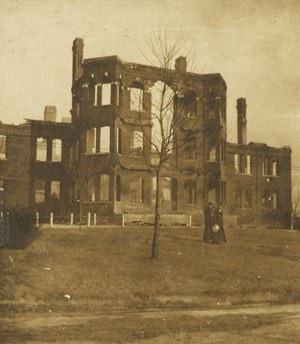
January 22, 2013 - April 10, 2013
The Martha Blakeney Hodges Special Collections and University Archives invites students,
faculty, and researchers to learn more about the various tragic events that occurred on the
campus of The State Normal and Industrial School (now UNCG) from its opening in 1892 to
1932 by viewing the recently installed exhibit “Tragedies on Campus: The Early Years, 1892-
1932.” Using archival documents and photographs, the exhibit explores the fires in the Brick
Dormitory, the Carnegie Library, and in the Curry Building. In addition, there is a focus on the
typhoid epidemic of 1899 which killed 13 students and the sudden passing of founding President
Charles Duncan McIver in 1906.
The archives also encourages you to learn more about these and other tragic events that
happened throughout the university’s history by visiting our Research Guide, available at: http://uncg.libguides.com/scua_campus_tragedies
This exhibit will be on display in the vertical display case between the EUC and the library from
January 22, 2012 – April 10, 2013.
The Martha Blakeney Hodges Special Collections and University Archives is open Monday
through Friday, 9am until 5pm. For questions or comments, please contact the exhibit curator,
Sean Mulligan at 336-334-5763 or at Sean_Mulligan@uncg.edu.
Woman's College Home Economics Major to Army Dietitian: Caroline Morrison Garrett Papers
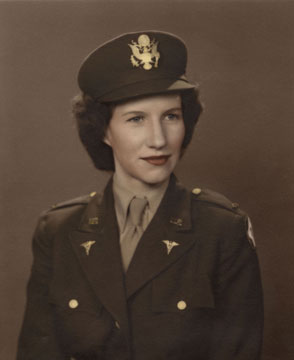
November 5, 2012 - February 2013
Caroline Morrison Garrett attended the Woman's College (WC) of the University of North Carolina (now UNC Greensboro) from 1941 to 1944. After graduating with a bachelor of science in Home Economics, she completed a yearlong dietetic internship and apprenticeship at Walter Reed General Hospital in Washington, D.C. Upon completion of her apprenticeship, Garrett received the rank of 2nd lieutenant with the United States Army Medical Corps and served until August 1947.
The exhibit features replicas of photographs, correspondence and memorabilia from Garrett’s time at the WC and her service in the military.
Campaigns and Elections: The Race for Political Office

September 1, 2012 – January 7, 2013. Hodges Reading Room
The Martha Blakeney Hodges Special Collections and University Archives invites students, faculty, and researchers to learn more about the history of political campaigns and elections in the United States by viewing the recently installed exhibit titled “Campaigns and Elections: The Race for Political Office.” The history of political campaigns and elections in the United States can be traced back to 1788 with the ratification of the Constitution. Over the next two centuries, the process of campaigning would evolve from simple word of mouth speeches to the complex and highly technical websites of today. In addition, the right for citizens to vote has greatly expanded. Originally reserved for only white male adult property-owners, voting rights are now available to women, African-Americans, and people of at least 18 years of age.
Using letters, campaign buttons, bumper stickers, yard signs, and other campaign paraphernalia, the exhibit explores the history of presidential, congressional, state gubernatorial, and local elections. Highlights of the exhibit include a signed letter by John F. Kennedy seeking support for his presidential bid, materials related to local Greensboro area Representative Howard Coble, a signed letter by North Carolina Senator Jesse Helms, and a letter and materials relating to Al Gore’s failed 1988 presidential bid.
This exhibit will be on display in the Hodges Reading Room from September 1, 2012 – January 7, 2013.
The Martha Blakeney Hodges Special Collections and University Archives is open Monday through Friday, 9am until 5pm. For questions or comments, please contact the exhibit curator, Sean Mulligan at 336-334-5763 or at sean_mulligan@uncg.edu.
Celebrating 120 Years of Education at UNCG
August 1 - October 31, 2012. EUC Connector
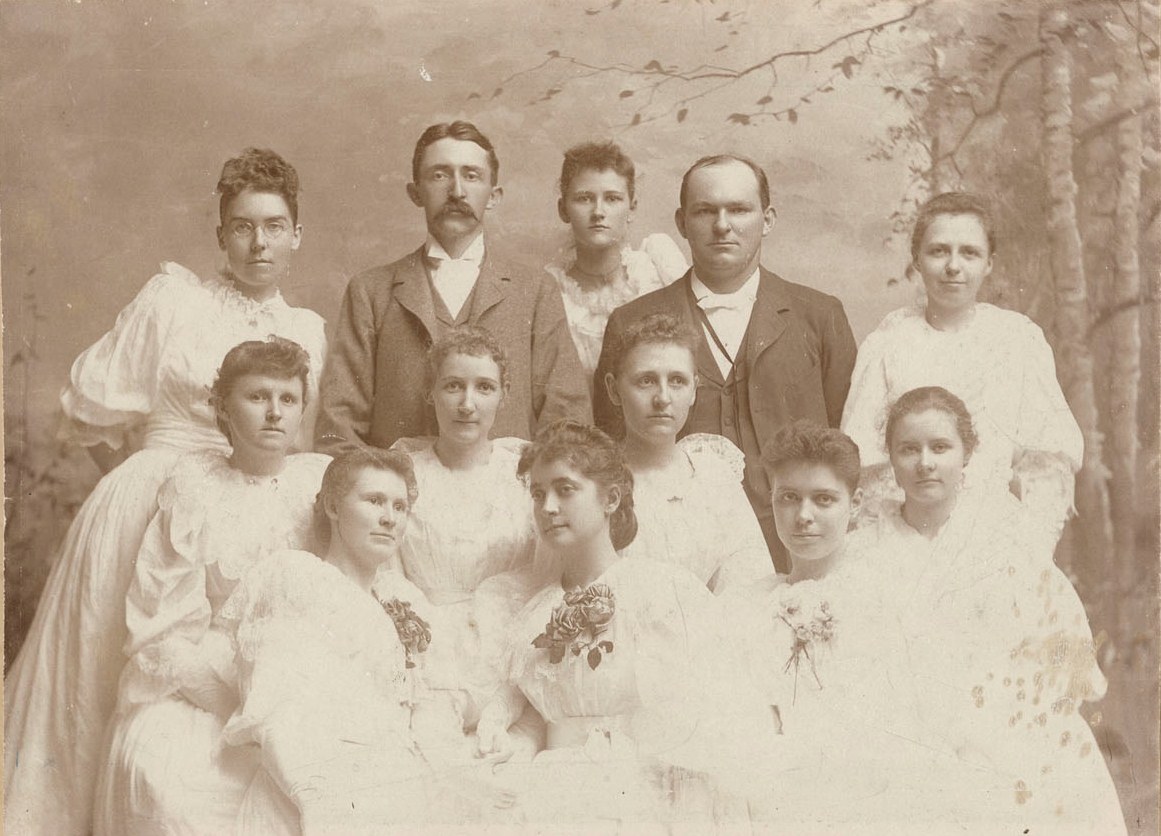
Drawing on records from the Martha Blakeney Hodges Special Collections and University Archives, a new exhibit “Celebrating 120 Years of Education at UNCG” highlights curriculum, faculty, and facilities available for education during the earliest years of the institution now known as UNCG.
Originally chartered by the State of North Carolina in 1891 as the Normal and Industrial School for White Girls, the institution was founded to train female teachers and instruct them in “drawing, telegraphy, type-writing, stenography, and such other industrial arts as may be suitable to their sex and conducive totheir support and usefulness.”
After a year spent planning the new school and constructing its facilities, the State Normal officially opened its doors for an initial class of 198 female students from across North Carolina on October 5, 1892. Classes offered were divided into three departments: normal (teaching), business, and domestic science. The normal, listed as the leading department, included pedagogy classes taught by school president Charles Duncan McIver as well as courses in English, history, mathematics, sciences, foreign language, art, music, and physical culture.
The exhibit features photographs of McIver with charter faculty members and students, photographs of classrooms and campus buildings, and biographical sketches of a number of early faculty members, including Dixie Lee Bryant, Gertrude Mendenhall, and Edwin Alderman. It will be on display in the EUC Corridor from August through October 2012.
McIver Statue Centennial: 1912-2012
May 1 - October 8, 2012. Jackson Library Lobby
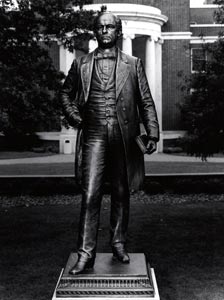
The Martha Blakeney Hodges Special Collections and University Archives is pleased to announce the installation of a new exhibit to celebrate the centennial of the Charles Duncan McIver Statue.
The exhibit contains historic artifacts and photographs relating to Dr. Charles Duncan McIver and the McIver Statue. From 1891 to 1906, Dr. McIver was president of the State Normal and Industrial College, now The University of North Carolina at Greensboro. He was not only the founder of this institution, the first public school in North Carolina for women, but was a nationally known educator.
The statue commemorates Dr. McIver's contributions to education and was dedicated on Founder's Day, October 5, 1912. This exhibit will be on display in the Jackson Library Lobby from May 1 - October 8, 2012.
North Carolina Literary Map Exhibit
May 1 – September 1, 2012. Hodges Reading Room
The Martha Blakeney Hodges Special Collections and University Archives is hosting an exhibit for the online North Carolina Literary Map. The exhibit includes historic photographs, rare books, manuscripts, and plenty of popular materials such as books by the famous North Carolina author Nicholas Sparks.
The literary map of North Carolina is a database-driven, searchable/browse-able, multi-level, multi- media online research tool created to foster interest in North Carolina's rich literary tradition. This is a collaborative project between the University Libraries at The University of North Carolina at Greensboro and the North Carolina Center for the Book, a program of the State Library of North Carolina, Department of Cultural Resources.
Almost any reader or person curious about North Carolina can find something of interest in the exhibit. Both prominent historical works and popular book titles are on display. For example, William Bartram's Travels through North and South Carolina, Georgia, and East and West Florida from 1793 as well as Margaret Marons' Up Jumps the Devil can be viewed.
Special thanks to the LIS graduate students who collaborated on putting together an exhibit that highlights some of North Carolina's best literary features.
See the World in Postcards: Selections from the Anna Gove Collection
February – June 30, 2012
EUC Connector
Dr. Anna Maria Gove was born July 6, 1867, in Whitefield, New Hampshire. After her education at MIT and Woman's Medical College of New York Infirmary, from which she graduated in 1892, Dr. Gove served for a year in the New York Infant Asylum. In 1893 she came to the State Normal and Industrial School (now UNCG) where she served as resident physician, professor of hygiene, and director of the Department of Health until her retirement in 1937.
Fond of travel, Dr. Gove visited many parts of the world. In 1896 and again in 1914, she visited Vienna for postgraduate study. During WWI, she served with the Red Cross in the Children's Relief Division in Marseilles and Ardèche, France. In 1926, she took a leave of absence from the college to travel extensively in the Orient. She also spent many summers in study and clinical work in the United States at Cornell, Chicago, New York and Michigan. Dr. Gove died in Greensboro on January 28, 1948.
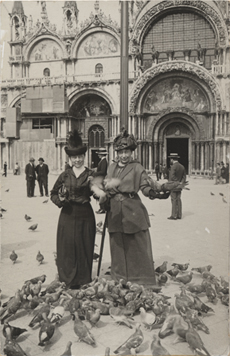
The Anna Gove Collection contains hundreds of postcards from the early to mid-20th century, reflecting Dr. Gove’s travels as well as those of her friends. This exhibit will feature, on a rotating basis, postcards from Europe, Asia and the Middle East, and the United States.
Windows to the World: The Immortal Works of Charles Dickens
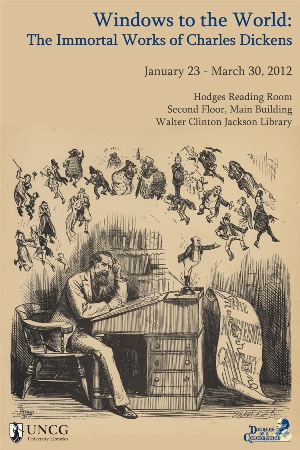
January 23 2012 - March 30, 2012
Hodges Reading Room
Second Floor, Main Building
Jackson Library
Dickens Exhibit Catalog 2012
With the possible exception of Shakespeare, no English author is better known than Charles Dickens. Dickens was a household name during his lifetime, and his reputation has not dimmed with the passage of time. This exhibit, which includes twelve of his most popular books—the majority represented in first editions—illustrations from his works, and an assortment of ephemera, celebrates the bicentennial of his birth on February 7, 1812.
Dickens won the admiration and praise of his readers, critics, and fellow authors; and countless books and articles have examined and heralded his life and writings. His grave in the Poet's Corner of Westminster Abbey represents the highest tribute paid to an English author.
This exhibit attempts to allow Dickens's genius to speak for itself, in his own words about his work and in the words of his immortal characters.
Illustrations—most of them the original illustrations—are included for each book. Dickens was one of the first authors with the power to select his own illustrations, thus giving them a particular significance as interpreters of his characters and events. He worked with some of the most distinguished artists of his day—George Cruikshank, Hablot Browne ("Phiz"), George Cattermole, and Marcus Stone foremost among them.
The many items in the exhibit that carry his name—commemorative plates, medallions, plaques, playing cards, etc.—show that perhaps no author in history has been commercialized more than Dickens. Although Dickens would undoubtedly have railed against this exploitation,it bears testimony to his immense and enduring popularity.
It is difficult to choose a single comment to summarize this great author's life and work, but the words of his biographer G. K. Chesterton in 1906 ring true:
"The positive argument for the permanence of Dickens comes back to the thing that can only be stated and cannot be discussed. He made things which nobody else can possibly make."
Thanks are due to Richard Levy, Norman Smith, and Kimberly Lutz for lending items to this exhibit, and to Carolyn Shankle for devoting time to designing this catalogue and the exhibit poster.
What They Were Wearing While They Were Reading: 1930s
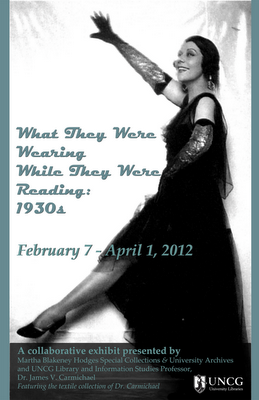
February 7 - April 1, 2012
Main Lobby, Jackson Library
After the years of economic prosperity, the stock market crashed on October 29, 1929, and the resulting economic depression dominated the entire decade. During this Great Depression, millions of Americans lost their jobs, their savings, and their homes. While banks foreclosed on businesses and farms, families became homeless and unemployed. Many Americans took to the road and the rails, traveling from town to town in search of a job. Shantytowns, known as "Hoovervilles" after President Herbert Hoover, began to spring up on the outskirts of town. Created with scraps of cardboard, newspaper, and anything else that could be picked up on the street, these makeshift towns housed thousand of transient families.
Americans pinned their hopes on the winner of the 1932 presidential election, Franklin D. Roosevelt. Upon taking office, Roosevelt began to establish governmental programs known as the "New Deal," to help Americans pull out of the economic crises. Programs such as the Agricultural Adjustment Administration targeted farmers while the Works Progress Administration helped unemployment by hiring people to work on civic building projects. While these New Deal programs helped ease the hardships of many Americans, the decade continued to be plagued with economic instability.
It was the entrance of the United States into World War II after the bombing of Pearl Harbor in December of 1941 that ended the Great Depression.
The Life and Art of Maud Gatewood
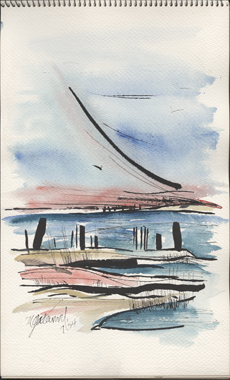
January 2011
EUC Connector
Maud Florence Gatewood was a widely recognized Southeastern painter who graduated from the Woman's College of the University of North Carolina (now The University of North Carolina at Greensboro) with a Bachelor of Arts degree in 1954. Her most familiar work features natural landscapes and botanicals as well as figurative designs that depict various aspects of the human experience.
The upcoming exhibit will include selections from the correspondence, sketchbooks, sketches and artwork, exhibition materials, reviews, photographs, and artifacts which comprise the Maud Gatewood Collection.
Making Their Mark: Historical Signatures in the Archives
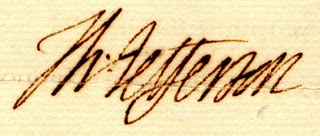
October 10, 2011 - January 16, 2012
Hodges Reading Room
Throughout history, signatures have wielded great power and importance. From John Hancock’s elaborate signature on the Declaration of Independence in 1776 to General Douglas MacArthur signing the Japanese’s surrender documents in 1945, a person’s signature has conferred identity and intent. Latin for “to sign,” a signature is a handwritten and sometime stylized description of a person’s name. The way in which a person writes his or her name changes throughout their life. However, just like a thumbprint, each person’s signature has its own unique characteristics.
The history of signatures can be traced back to 3000 B.C. when the Sumerian culture would affix seals to documents as a way to confirm authenticity. As the evolution of writing and the alphabet progressed, the use of handwritten representations of one’s name on documents to denote legitimacy and purpose expanded. To combat forgery, the Roman Empire created public notary’s who were minor government officials responsible for verify the identity of individuals and their signature. The use of signatures expanded beyond just formal documents with the rise of literacy and individualism during the Renaissance era (1300-1600 A.D) when people began to be recognized for their genius and achievement. The result was the artist’s signature and with it a new step in the evolution of the use and meaning of signatures.
While signatures are still used in today’s society to confirm identity, intent, and credit, they have also spawned a new phenomenon: autograph collecting. People who are into philography, the term used to describe the hobby of autograph collecting, seek a variety of signatures including those of Presidents, sports figures, celebrities, and other historical figures. While some people collect autographs simply for their historical value, others do so for profit. One of the most famous signatures in world is Abraham Lincoln’s whose autograph fetched $748,000 in 1991.
In recognition of the importance of signatures to history, The Martha Blakeney Hodges Special Collections and University Archives has selected from its collections a sample of historical signatures. Spanning over 220 years of United States history, the signatures touch on such issues as: women, North Carolina, Americana, UNCG, and U.S. Presidents. Some of the highlights from the exhibit include signatures by President Thomas Jefferson, woman suffrage movement activist Susan B. Anthony, scientist Albert Einstein, UNCG founder Charles Duncan McIver, and inspirational figure and advocate Helen Keller. This exhibit will be on display in the Hodges Reading Room from October 10, 2011 – January 16, 2012.
Vintage Gym Suits from the University Archives Collection
October 13, 2011 - November 1, 2011
The Martha Blakeney Hodges Special Collections & University Archives has installed a new exhibit titled "Vintage Gym Suits from the University Archives Collection" in the three exhibit cases next to the Reference Desk. The exhibit contains vintage photographs as well as a 1913 black serge gym Suit, 1930s blue cotton gym suit, and 1950s white cotton gym suit. The exhibit will be on display until November 1, 2011.
The exhibit was requested by Department of Kinesiology professor Donna Duffy for the Conference on Girls and Women In Sports and Physical Activity that will be held October 20-22 in Elliott University Center and the Alumni House.
History of Men’s Athletics at UNCG
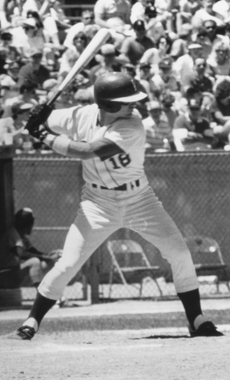
January 7 2011
EUC Connector
The Martha Blakeney Hodges Special Collections and University Archives designed this exhibit to celebrate the history of men’s athletics at The University of North Carolina at Greensboro.
Athletics has been an important aspect of campus life since the University opened in 1892 as a school for women. This exhibit portrays a visual history of men’s athletic tradition since the University became coeducation in 1963.
This exhibit will be on display in the Jackson Library/Elliott University Center Connector from January 7 – April 7, 2011.
Scrapbooking at UNCG: The Art of Documenting Student Life
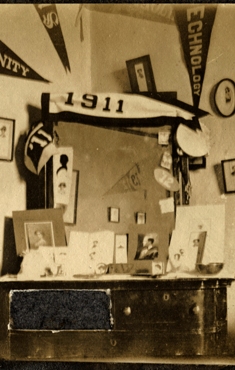
June - September 2011
Hodges Reading Room
The Martha Blakeney Hodges Special Collections and University Archives invites the UNCG community and the general public to view the new exhibit of student scrapbooks on display in the Hodges Reading Room. The scrapbooks include photographs, programs, and memorabilia that present a picture of what life was like as a student at UNCG during the late 19th and early 20th century.
The exhibit will be on display in the Hodges Reading Room until September 30, 2011.
The University of North Carolina at Greensboro: The First Hundred Years, 1891-1991
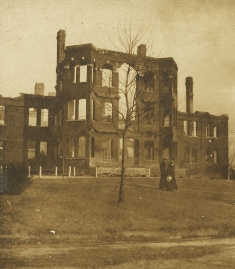
June 1 - September 30, 2011
Jackson Library Lobby
The Martha Blakeney Hodges Special Collections and University Archives invites the UNCG and greater Greensboro community to witness the birth and development of The University of North Carolina at Greensboro through artifacts, documents, and images from the University Archives. This exhibit tells the story of how a small college, founded on ten acres of farmland in 1891, was able to overcome early setbacks to develop into the large, thriving University it is today. Divided into five eras corresponding to the names under which the University operated, the exhibit highlights important historical events including the Brick Dormitory fire of 1904, the death of founding president Charles Duncan McIver in 1906, and the growth of the College under Julius Foust. It also emphasizes the changes in student life including the introduction of college traditions such as Rat Day, the desegregation of the School in 1956, and the enrollment of male students in 1964. This exhibit will be on display in the Jackson Library Lobby from June 1 – September 30, 2011.
May Day Celebrations
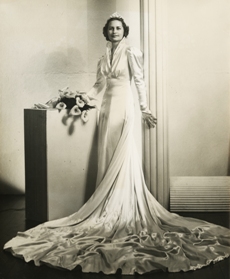
April 25 - June 15, 2011
Jackson Library Lobby
The Martha Blakeney Hodges Special Collections and University Archives is pleased to announce an exhibit of May Day artifacts, photographs, and postcards commemorating May Day festivals that were held on this campus in the first half the Twentieth Century.
The College hosted May Day pageants from 1904 to 1954 with the 1912 and 1916 festivals being the most elaborate.
This exhibit will be on display in the Jackson Library Lobby from April 25 to June 15, 2011.
School Spirit at UNCG: Banners and Pennants
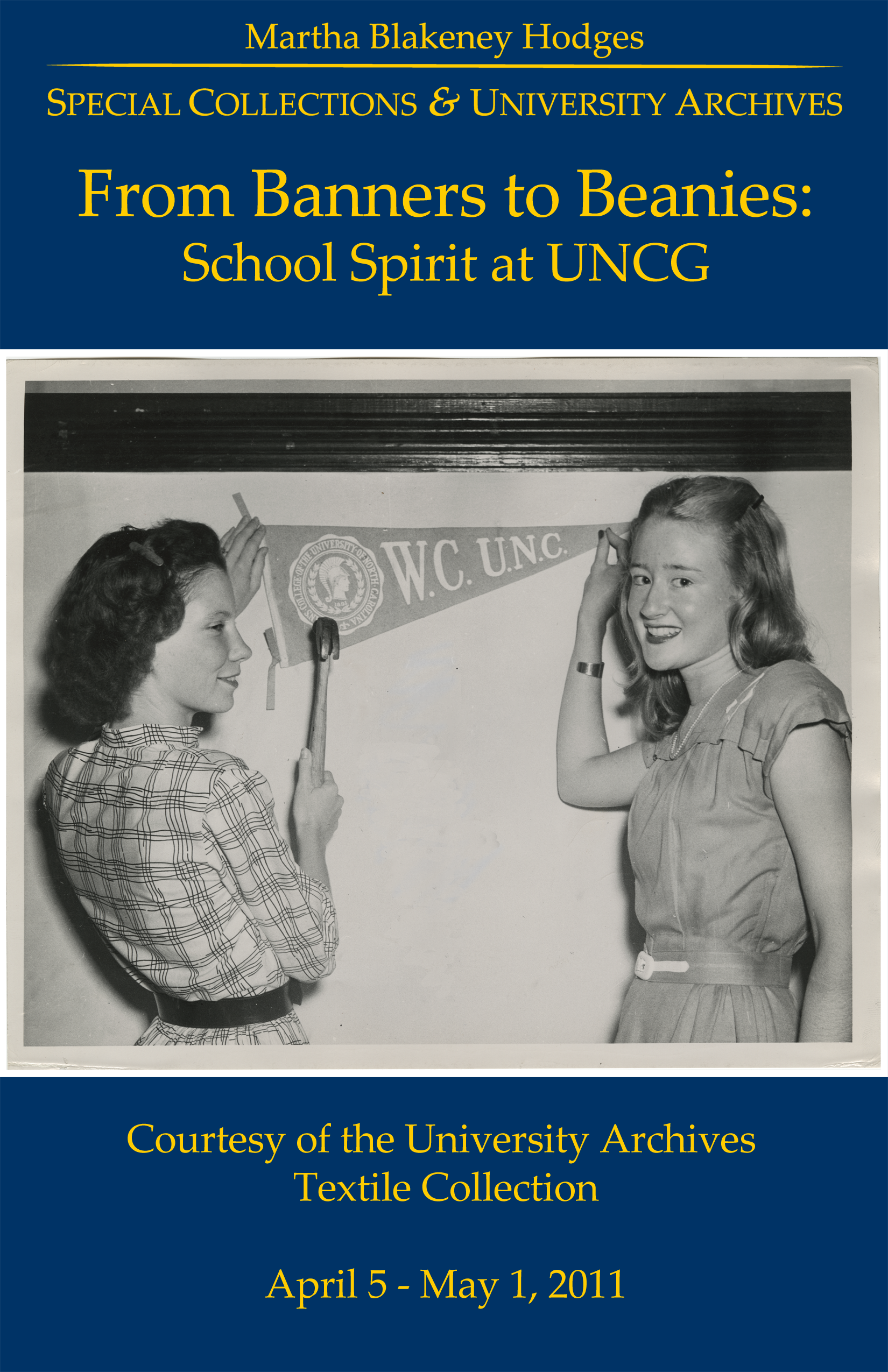
April 5 - May 1, 2011
Five Exhibit Cases Across from Reference Information Desk
Banners and pennants have been part of college life since the
early twentieth century, but they have a long and remarkable history.
The word “banner” originates with the Latin word “bandum,” meaning
a cloth used to make flags. Throughout early history, banners
accompanied official proclamations or edicts. They were decorated
with heraldry and were commonly used in battle as rallying points and
as a way to identify units of soldiers. Early square or rectangular
banners led formal processions and could also be seen as decorative
additions to churches, castles, or manors.
On the UNCG campus, banners were created by each class,
displaying the graduating year or the class motto. During reunion
weekends, class banners were used for gathering points and for the
alumnae parades.
Pennants had a nautical beginning. They began as long, tapering,
triangular flags, used on ships for identification or to signal other
vessels. The triangular pennant shape was used in recent years to
recognize sports teams, especially professional baseball teams. The
pennants’ association with college sports made it a common sight in
college dormitory rooms and soon college’s themselves were
represented, usually incorporating school colors.
UNCG has a long and rich history of class pennants. Students used
large pennants, sporting their class graduation year and decorated with
their class colors, to represent themselves at gatherings and sporting
events. Smaller versions, using school colors and the current school
name, decorated dormitories and can still be purchased in the campus
bookstore.
Lois Lenski: Voices of Children
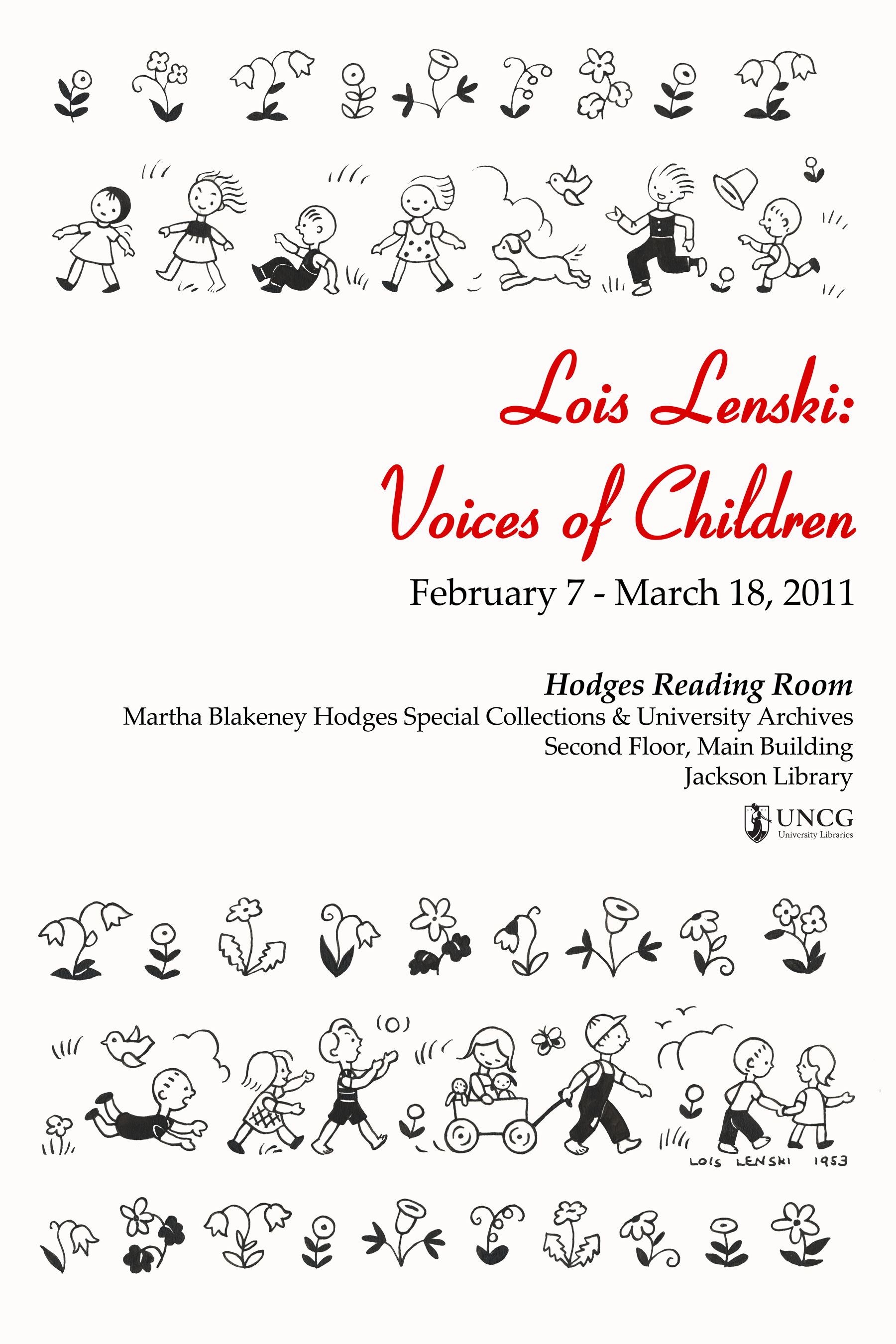
February 7 2011
Hodges Reading Room
Lois Lenski (1893-1974) was one of the most popular and most gifted among children's authors and illustrators of the twentieth century. This small exhibit is an attempt to document her talent and to show, in her own words, her intense feelings for the proper literature and education for children.
Born and reared in Ohio, Lenski gravitated early to a career in art. Although she majored in education at Ohio State University and prepared for a career in teaching, she took many art courses in college, decided on art as a vocation, and pursued this career at the Art Students' League in New York, furthering her art studies in England and Italy. At the Art Students' League,she became an assistant to the muralist Arthur Covey and married him in 1921. Advancing from part-time jobs designing greeting cards and drawings for advertisements, Lenski spent the decade of the 1920s illustrating the works of others, primarily for children's books. In addition to illustrating works such as Padraic Colum's The Peep-Show Man and Kenneth Graham's The Golden Age and Dream Days (which allowed her to exercise her passion for medieval costume and culture), she developed an association with the New York publishing firm Platt and Munk, illustrating such well-known works as Cinderella and The Little Engine That Could.
At the suggestion of an editor, Lenski decided to try her own hand at writing for children, publishing in 1927 Skipping Village, based on her own childhood experiences in Anna, Ohio. In her long and illustrious career as both writer and illustrator, Lenski authored more than eighty books for children of various ages, including the immensely popular "Davy" and "Mr.Small" series for younger readers and the influential and provocative "Roundabout America" and "Regional America" books for older children, as well as historical novels and poetry. In addition to providing riveting entertainment, her books invariably made a plea for tolerance and understanding among all people. Among her many awards were the Newbery Medal for 1946 for Strawberry Girl, one of her fifteen regional novels for young readers, and the National Child Study Association Award in 1948.
Special Collections & University Archives, Jackson Library, has many signed first editions, translations, manuscripts, original art work, artifacts, and ephemera in its Lois Lenski Collection, as well as a collection of miniature and early children's books collected by Lenski.
For her many contributions to children's literature, Lois Lenski in 1962 was awarded an honorary degree of Doctor of Humane Letters by the University of North Carolina at Greensboro.
Class Jackets
April, 5 - 25, 2011
Five Exhibit Cases Across from Reference Information Desk
The tradition of Class Jackets made its debut at Woman’s College (now UNCG) in the late 1920s. The
colors of the Jackets corresponded with the rotating class colors; green, red, blue, and lavender.
Lavender was not a popular color with the students and they never chose to wear lavender Jackets.
On those years, they wore black, charcoal grey, or camel-colored Jackets. Occasionally, there would be
a year where the Jackets would not correspond to the class color. For example, in 1941 the girls wore
white leather Jackets.
The distinctively colored Jackets were purchased during their sophomore year. On Jacket Day, all
sophomores received their Class Jackets, signifying their status as upperclassmen. The Jackets were
worn by the students for the remainder of their college days. By the mid-1970s, the tradition of the
Class Jacket at UNCG had disappeared.
What They Were Wearing While They Were Reading: The 1920s
January 24 – March 31, 2011
First Floor Lobby, Jackson Library
The 1920s was one of the most exciting decades in US history. It was a time of prosperity and excess when Americans embraced a modern culture, which included dancing to the “Charleston” and joyriding in Ford Model T automobiles. Women won the right to vote, attended colleges in droves, and sought out careers outside the home.
Prohibition began on midnight, January 16, 1920, making “intoxicating liquors” illegal to transport, consume, or sell. Prohibition created an underground bootlegging industry, which fueled widespread criminal activity. Men like Al Capone rose to power, ordering the largest gangland hits in crime history known as “the St. Valentine’s Day Massacre.”
Jazz was hot! Singers such as Charles Peterson, Louis Armstrong, Bing Crosby, and Rudy Vallee were popular and could be heard on a new invention, which allowed entertainment to be broadcast into America’s living rooms - the radio. Americans were also flocking to movie theaters to see popular stars as Rudolph Valentino and Gloria Swanson.
Other important milestones of the 1920s included Babe Ruth setting the home run record in 1927, celebrity pilot Charles Limbergh flying solo across the Atlantic in 1927, and archaeologist Howard Carter discovering the tomb of Tutankhamen in 1922.
The decade came to a screeching halt on October 29, 1929, with the most devastating stock market crash in US History. The panic of 1929 sparked the Great Depression and the economic downturn of the 1930s.
This exhibit focuses on the fashions, literature, and cultural aspects of the 1920s. It features the textile collection of Dr. James Carmichael, professor of the UNCG’s Library and Information Studies program.
Women Airforce Service Pilots of World War II
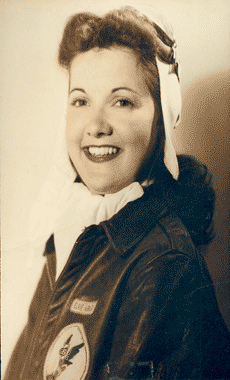
October 26 – April 1, 2011
Main Floor of Jackson Library
During World War II, the United States was faced with a severe shortage of military pilots. In July 1943 the Women Airforce Service Pilots (WASP) was formed to train women to fly military aircraft so male pilots could be released for combat duty overseas.
Women who joined the WASPs were required to have flight experience before they joined, and then were sent to Avenger Field in Sweetwater, Texas, to be retrained to fly “the Army way” by the U.S. Army Air Force. 1078 women earned their wings and became WASPs, the first women in history to fly American military aircraft.
Unlike the other women who served and received military benefits during WW II, the WASPs were denied that same military status. Thirty-five years after their deactivation in December 1944, Congress finally recognized their military service and granted them the veteran status they had earned--but without most of the benefits other veterans received.
On July 1, 2009 President Barack Obama and the United States Congress awarded the WASPs the Congressional Gold Medal.
Celebrating the Cello Music Collection: The Greenhouse Legacy
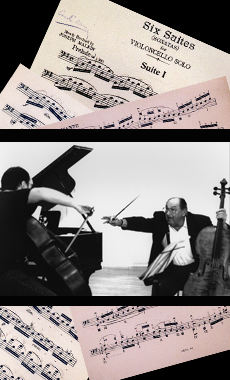
January 24 – February 3, 2011
Hodges Reading Room, Second Floor Main Building, Jackson Library
Among the most distinguished cellists of the 20th and early 21st centuries, Bernard Greenhouse, now in his 95th year, continues to teach at his home on Cape Cod and to inspire music lovers the world over, largely through his many recordings with the Beaux Arts Trio. As the founding cellist of this legendary trio, Greenhouse joined forces in 1955 with pianist Menahem Pressler and violinist Daniel Guilet (later followed by Isidore Cohen) to perform and record the entire standard piano trio repertoire before retiring from the group in 1987. However, as Greenhouse is ever quick to point out, his career on the international chamber music stage represents only one dimension of a richly varied musical life. This exhibit of materials from his personal library, now part of UNCG’s monumental Cello Music Collection, throws welcome light on the range of Greenhouse’s activities—as a virtuoso cello soloist, as a student of Casals, as a collaborator with composer Elliott Carter, and as the long-time cellist of New York’s Bach Aria Group.
Bound to Please: Custom Bookbindings by Don Etherington and Monique Lallier
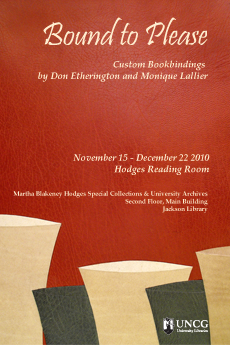
November 15 – January 25
Hodges Reading Room
Among the most renowned bookbinders and conservators practicing their craft today, Monique Lallier and Don Etherington have produced scores of beautiful and creative bindings, among them award winners in major competitions.
Monique Lallier has served as director of the American Academy of Bookbinding and as chair of the Standards Committee of the Guild of Book Workers. Her binding designs have been featured in many prominent exhibitions throughout the world, and among her awards was the De Golyer Jury Prize for Design in 2003. Monique has conducted many seminars and workshops on binding and tooling in the U. S. and abroad and maintains a binding studio at her home in Summerfield, where she continues to train apprentices in the art of custom binding.
Don Etherington is renowned as both a leading conservator and a creative bookbinder and has conducted numerous seminars and workshops in both areas. The founder of Etherington Conservation Services and a major consultant on such projects as the Florence reclamation project of 1966 and the restoration and housing of such precious documents as the Magna Carta, the Declaration of Independence and the U. S. Constitution, Don has his bindings represented in major public and private collections in the United States and abroad, including the British Library, the Victoria and Albert Museum, and the Library of Congress.
University Libraries is proud to display its seventeen custom bindings by Don and Monique, a small showcase of the art of two very talented and creative binding designers.
Happy Birthday Charlie:
Celebrating the 150th Birthday of President Charles Duncan McIver
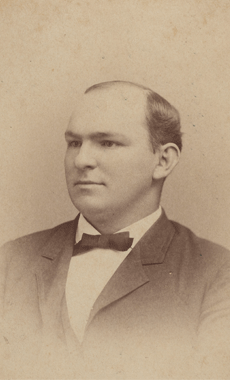
October - November 2010
Jackson Library/EUC Connector
Special Collections and University Archives designed this exhibit to celebrate the 150th birthday of the University of North Carolina at Greensboro’s first president.
Charles “Charlie” Duncan McIver was born September 27, 1860, in Moore County, North Carolina. After graduating from the University of North Carolina at Chapel Hill in 1881, he held several positions in education including assistant headmaster at the Durham Presbyterian Male Academy, principal of the Durham graded high school, teacher at the Winston Graded School, and head of the literary department at Peace Institute in Raleigh.
From 1891 until his death in 1906, McIver was the first president of the newly established State Normal and Industrial School, now the University of North Carolina at Greensboro.
Walter Clinton Jackson and the History of Jackson Library
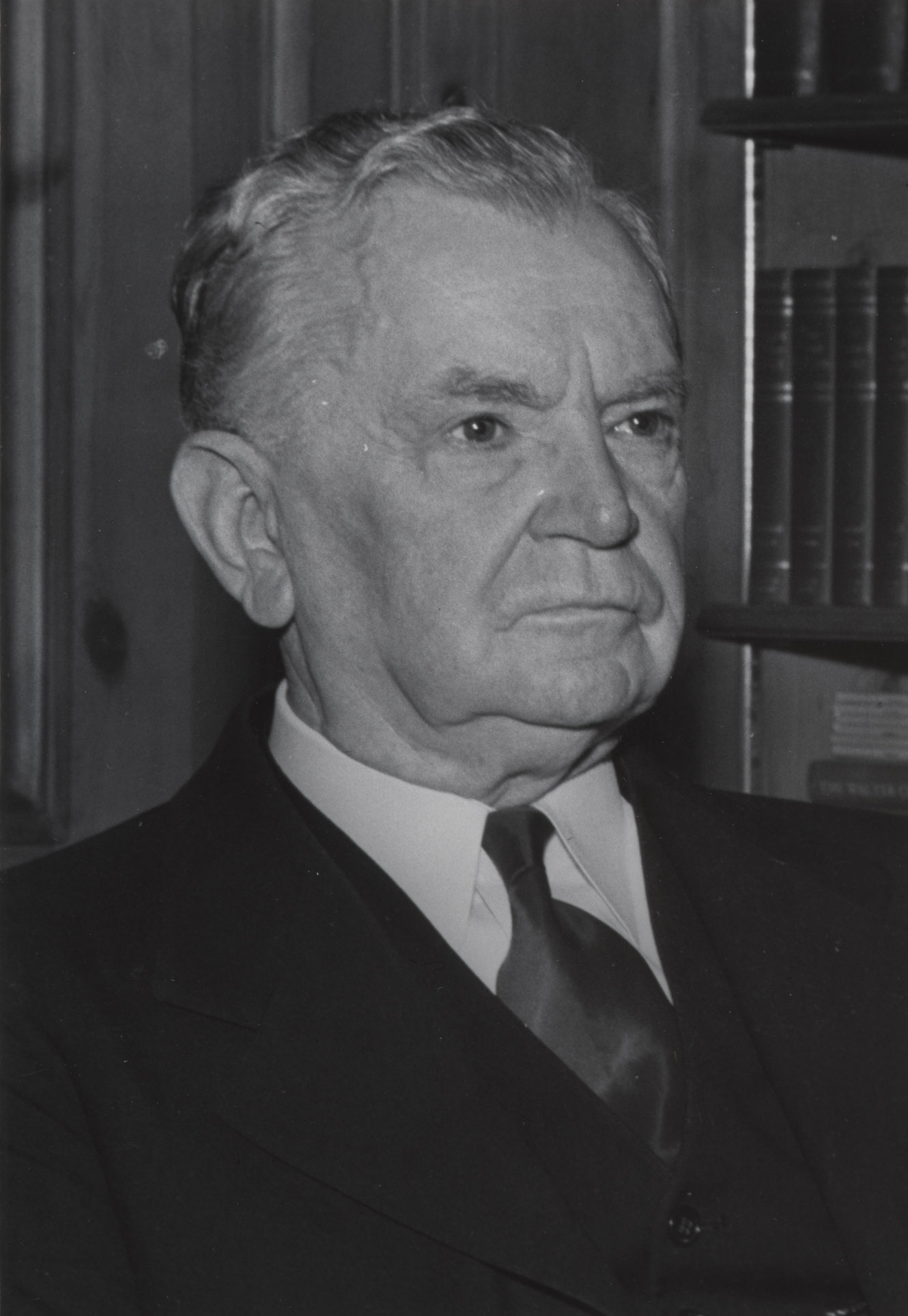
March 2010 - November 2010
Vertical display case in the ECU connector
This archival exhibit documents the life of Chancellor Walter Clinton Jackson and his connection to Jackson Library. Walter Clinton Jackson was born in Hayston, Georgia on June 18, 1879. In 1909, he joined the State Normal and Industrial School (now UNCG) faculty as a professor and then later became head of the Department of History. In 1934 he was appointed the third Chief Executive of the College and served 16 years as Chancellor. In 1948, ground was broken for the construction of a new library on campus. It was completed in 1950 and was officially named Jackson Library in honor of W.C. Jackson in 1960.
A Gentleman's Library: The Classic Book Collection of Norman B. Smith
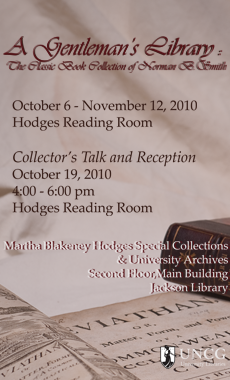
October 6 – November 12, 2010
Hodges Reading Room—2nd Floor Jackson Library
The twenty-six books in this exhibit represent but a small sampling of Norman B. Smith's library, a choice collection of the most significant and most influential books of many nations, dating originally from the Classical Age through the twentieth century.
Included are such well-known titles as The Wealth of Nations andAlice's Adventures in Wonderland. Also included are lesser known but highly influential works such as James Harrington's Oceana and Juliana Berners' Treatyse of Fysshynge. Important religious texts include the Geneva Bible, The Koran, a 1435 Book of Hours, and an Armenian Gospel of St. Mark from the seventeenth century. Important political texts include a 1556 printing of the Magna Charta, Hobbes' Leviathan, and Rousseau's Social Contract.
Campus Sports
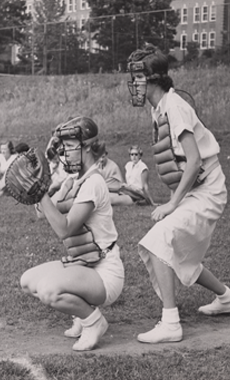
October 11 – October 25, 2010
Main Floor of Jackson Library
Sports have always been a central component of the student experience. Initially, campus sports were established at the newly formed State Normal and Industrial School with the primary goals of improving the girls’ postures and general physical fitness. The establishment of the Athletic Association (A.A.) in 1900 introduced intramural sports to the college, recognizing that physical training was equally important as academic training. By 1910, the College’s formal physical education curriculum included tennis, baseball, field hockey, and basketball. The same year, “Field Day” was established as an entire day just for athletic events.
During the late 1920s, more informal activities were introduced in the form of intramural sports, focusing on equipping each girl with “skills that would assist her in meeting the demands of society in terms of physical, mental, and emotional fitness.” 1928 saw the introduction of the first “Gym Meet” as well as the first “Play Day,” which mixed women from different schools together forming teams to play a variety of sports or games.
By the 1950s the physical education curriculum was moving toward the development of the individual and reflected the desire to produce a girl who could “function efficiently in a democratic society.” These selected gym suits reflect the College’s evolving philosophies of physical education.
The Sit-Ins: Woman's College Perspective
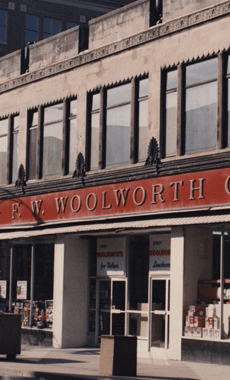
April 1 – October 11, 2010
Jackson Library/EUC Connector
Drawing from material located in the Martha Blakeney Hodges Special Collections and University Archives, this exhibit was created to reflect the Woman’s College perspective of the Greensboro Sit-ins.
On Monday, February 1, 1960, four North Carolina A&T State College students initiated what would become a nationwide protest when they demanded the right to sit and be served at the Woolworth’s lunch counter on South Elm Street in downtown Greensboro.
Woman’s College (now UNCG) students Eugenia Seaman, Marilyn Lott, Ann Dearsley, and Claudette Graves joined the protests later in the week. The presence of the three white women on Thursday, February 4 was particularly noteworthy. The young women felt that it was their “moral obligation” to join the protest in spite of possible reprisals from the gathering white crowd.
Campus Views, 1992-1995: Aerial and Panoramic Scenes of the UNCG Campus
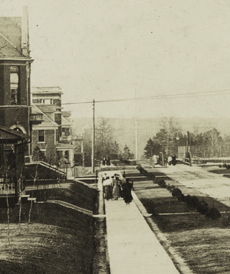
June – September 1, 2010
Second Floor Lobby of Jackson Library
Drawing from the extensive University Archives Photograph Collection, staff from the Martha Blakeney Hodges Special Collections and University Archives, created an exhibit of aerial and panoramic images of The University of North Carolina at Greensboro campus dating from 1892 to 1895.
100 Years of Theatre at UNCG
June – September 2010
Hodges Reading Room
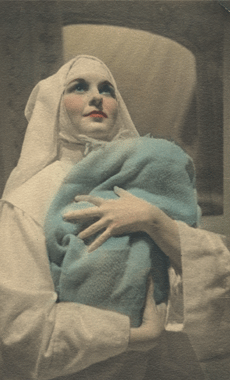
The Martha Blakeney Hodges Special Collections and University Archives selected almost 100 theatre production images from the extensive University Archives Photograph Collection for this exhibit.
For over 100 years, theatre productions have been given at the University of North Carolina at Greensboro (UNCG). This exhibit of photographs showcases some of the plays and theatre productions that have been presented on the UNCG campus since the 1890s.
Selections from the Arnold Doren Collection
May 15 – September 15 2010
Jackson Library/1st Floor Reference Area
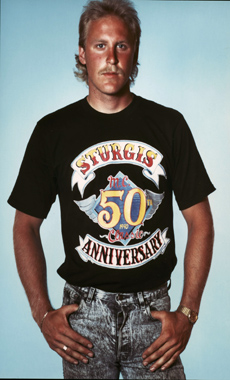
Arnold Doren saw the world through the lens of a camera. He traveled the world, capturing photographs of people, places, and events.
Doren, who died in 2003, was a professor in the Art Department at UNCG from 1978-2002. Recently, the Martha Blakeney Hodges Special Collections and University Archives acquired over 70 boxes of prints, slides, and negatives taken by Doren.
The rotating exhibit featured photographs in the following catagories: Italy, Spain, and China; Landscapes of the American Southwest; Children around the World; and the Sturgis Motorcycle Rally.