

During her long and politically influential life, Eleanor Roosevelt made several visits to the North Carolina College for Women, now called The University of North Carolina at Greensboro (UNCG). Her first visit occurred in November 1931 as part of a campaign stop during her husband’s, Franklin Delano Roosevelt, 1932 bid for the United States presidency. She was described by the local papers as “the wife of the presidential candidate” with great personal charm whose grandmother had familial connection to a prominent family in Savannah, Georgia.
As part of her 1931 visit, Mrs. Roosevelt spoke to the students in Aycock Auditorium on the subject of “Opportunities for Modern Women in the Business World.” While hesitant to express any strong political opinions in newspaper interviews, Mrs. Roosevelt was not shy in articulating her clear support for women seeking second careers after their children had left the home. She also predicted that women would eventually have a growing role in American politics and that someday soon, political candidates would be chosen based on their qualifications and not on their gender. The following November, Franklin Roosevelt defeated presidential incumbent Herbert Hoover to become the 32nd president. During his next twelve years in office, Eleanor Roosevelt would establish herself as one of the most important women in politics.
 |
| Mrs. Roosevelt meets with Dr. W. C. Jackson and Student Government Association president, Woody Hewett during her 1945 visit |
Mrs. Roosevelt’s second visit to the Woman’s College of the University of North Carolina (now UNCG), and the first in her role as the First Lady, occurred in March 1945. While touring the campus, she described it as “charming” and made several positive comments on the buildings that had been constructed by the Works Progress Administration, which was part of her husband’s New Deal Program. During her visit, she gave a speech that focused on the privilege of education and the responsibility of America’s youth in building a better world. Her day also included lunch with her personal friend Harriet Elliott, Dr. Walter C. Jackson, and members of the faculty, and tea at the Weil-Winfield Residence Hall with students. Before leaving Greensboro, Mrs. Roosevelt also visited the Overseas Replacement Depot, Bennett College, Greensboro College, and the Agricultural and Technical College of North Carolina (now North Carolina A & T University).
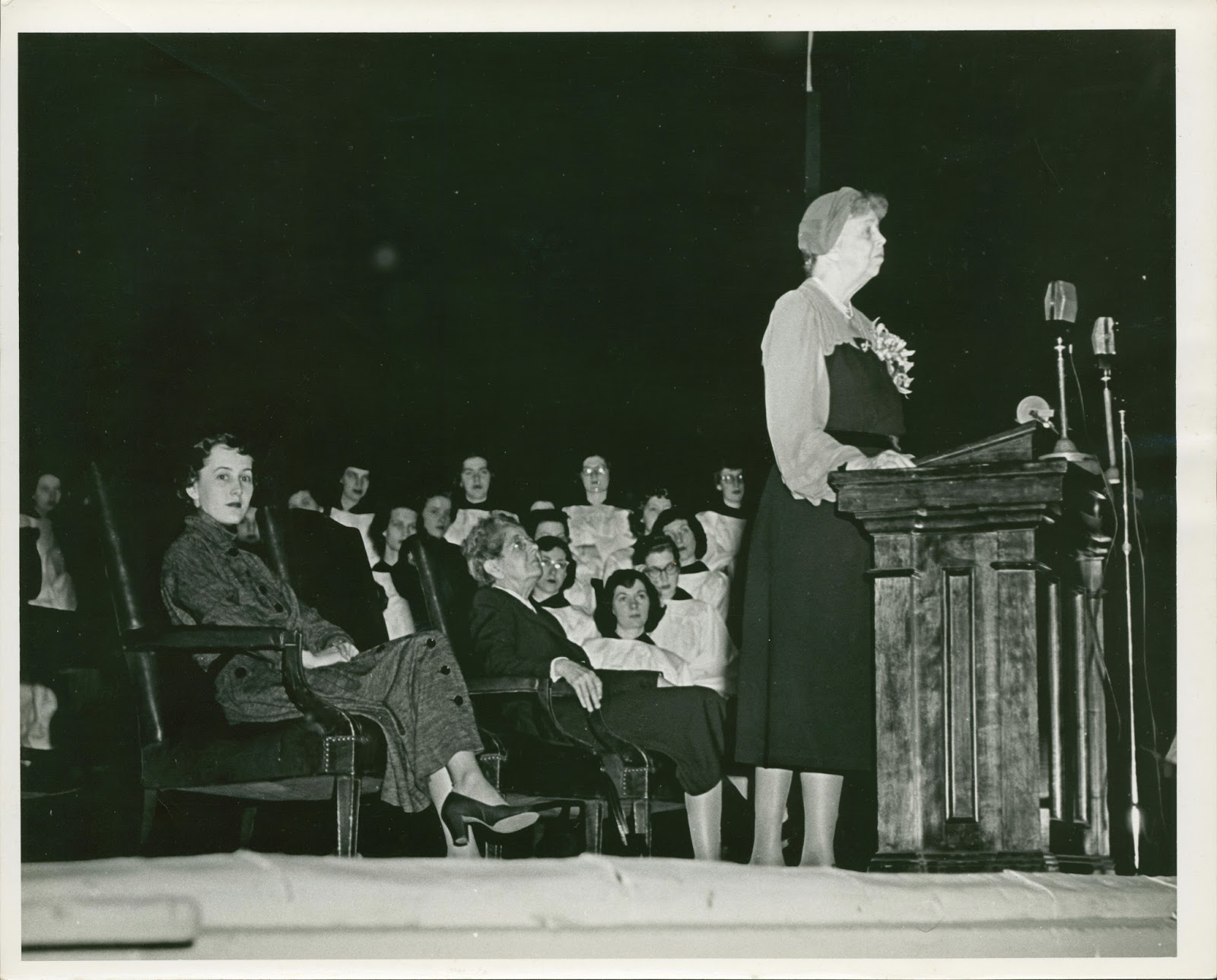 |
| Mrs. Roosevelt speaks to a capacity crowd in Aycock Auditorium during her 1953 visit |
Her third and final visit to the campus occurred in February of 1953, during which her message to the students of the Woman’s College focused on the United Nations (UN). In December 1945, President Harry S. Truman appointed Mrs. Roosevelt as a delegate to the newly established UN General Assembly. Addressing a capacity crowd in Aycock Auditorium, she gave what was considered an optimistic, but also realistic, speech on the current world condition, covering the politically strained relationship between the United States and Russia, the health conditions in India, and the importance of the UN as the last hope for world peace. Recognizing the serious tone of her talk, she attempted to lighten the mood by recounting tales of her early days in the UN. She described how her male colleagues were generally suspicious of her motives and fearing that she might do “something dangerous” she was placed on a committee where they though she couldn’t “do much harm.” To their surprise, Mrs. Roosevelt would go on to become the first chairperson of the UN Commission on Human Rights where she was instrumental in drafting the Universal Declaration of Human Rights. Mrs. Roosevelt remains one of the most illustrious and memorable persons to ever visit the UNCG campus.
Article by Kathelene McCarty Smith