Object ID: WV0083.5.001
Description: Primarily documents Marion Elizabeth Fisher’s early education; her service in Italy as an army dietitian during World War II; and her civilian dietitian work with the Veterans Administration and the Department of the Navy.
Summary: Fisher discusses her early education in Northampton, Massachusetts, and the Mary A. Bunham School for Girls. She explains her decision to attend the Woman’s College of the University of North Carolina (now the University of North Carolina at Greensboro) as a home economics major and briefly describes her time on campus in the late 1930s. Fisher also comments on her internship in dietetics at Massachusetts General Hospital from 1940 to 1941.
Fisher chiefly comments on her work as a civil service and army dietitian. Topics include her decision to go to Fort Bragg, North Carolina, in 1942 and the hospital set up on the base; her decision to join the army in 1943; preparations for overseas service, including the uniforms issued to her; and her parents reaction to having four children in the military. Fisher provides details about her service in Algeria, where she visited hospitals in Oran and Sidi Bel Abbes to learn about how overseas hospitals were run; her work with the 262nd Station Hospital in Aversa, Italy; and her brief time with the 17th General Hospital in Naples, Italy. Topics include hospital facilities; living conditions; her work planning menus; visiting Capri and Cassino; seeing Mt. Vesuvius erupt; bombings; social life in Naples; and celebration of VE Day. Fisher also describes a trip to Italy in 1970 when she returned to her duty stations in Aversa and Naples.
Fisher also discusses her post-World War II civil service work. She describes work as a hospital dietitian at various Veterans Administration hospitals and her work with the Department of the Navy’s Office of Food Service Systems Command, where she ran test kitchens and helped make training films for navy cooks.
Creator: Marion Elizabeth Fisher
Biographical Info: Marion E. Fisher of Northampton, Massachusetts, served as a dietitian with the civil service and then in the army from 1942 to 1945. After World War II she returned to civil service work with the Veterans Administration and the Department of the Navy until her retirement in 1974.
Collection: Marion Fisher Papers
Rights: It is responsibility of the user to follow the copyright law of the United States (Title 17, U.S. Code). Materials are not to be reproduced in published works without written consent, and any use should credit Jackson Library, The University of North Carolina at Greensboro.
Full Text:
EE:
My name is Eric Elliott, and today is May 25, 1999. I'm in Washington, D.C., this morning at the home of Marion Elizabeth Fisher. You go by Marion Fisher, it looks like at the front here.
MF:
Yes. Well, no. I have to put Marion Elizabeth now, or Marion E.
EE:
You have a daughter by that name?
MF:
No, I don't, but I sign all my accounts and everything else as Marion E.
EE:
Great. Well, thank you for having us here today. This is going to be an interview for the Women Veterans Historical Project at the University of North Carolina at Greensboro [UNCG]. As we talked about before we started the tape, Ms. Fisher, we start out with just some basic information about all the folks we interviewed, and the first question hopefully won't be the toughest. Where were you born and where did you grow up?
MF:
I was born in Northampton, Massachusetts, and I grew up in Northampton, Massachusetts. I went to school there, graduated from Northampton High School in '35 and from Mary A. Burnham School for Girls in '36.
EE:
Do you have any brothers and sisters?
MF:
I was the middle of seven.
EE:
About half and half on boys and girls?
MF:
Yes. Well, I had two brothers and a sister older and two sisters and a
brother younger.
EE:
What did your folks do?
MF:
My father was a roofing contractor. My mother was a homemaker.
EE:
And they were both from that area?
MF:
Yes.
EE:
You graduated in '35. Are you somebody who liked school?
MF:
Not necessarily.
EE:
So what did you have in mind of doing once you were in high school? What did you want to be when you grew up?
MF:
I really had no great plans for what I was going to be when I grew up. I just knew that I didn't want to teach school, and most of the people who went on to college in those days ended up being schoolteachers, and it was not for me to be a teacher. But, of course, I ended up doing an awful lot of teaching in my work.
EE:
What's that turn of phrase, we become what we hate? [chuckles] I don't know what the Mary A. Burnham School for Girls is. Tell me about that.
MF:
Well, Mary A. Burnham School for Girls was a private girls' school in
Northampton, but it is not there any longer. It collaborated with a boys' school
in Greenfield, Massachusetts. Northampton is an interesting town, Smith College
is located there, five miles away there is Amherst College and the University of
Massachusetts, which was then Massachusetts College. Ten miles away Mount
Holyoke College is located. Then there were girls' prep schools or boys' prep
schools in each town. So it was, and is to this day, a very educational area.
EE:
Was it a religious school?
MF:
No. It was a private girls' school.
EE:
So this was to get the equivalent of a junior college training?
MF:
It was before junior college.
EE:
Finishing school or something?
MF:
Finishing school and to prepare you for your college, whatever.
EE:
And when you went to that school you were thinking about going to a college
afterwards?
MF:
Yes.
EE:
How did you end up from Massachusetts at a place called Woman's College [now UNCG]?
MF:
Well, because I did not want to go to Smith, and there was a Woman's College
student in the next town. She gave me a copy of the newspaper that Woman's
College put out, there was an article in there about home ec[onomics] and dietitians. I
thought that would be a good profession. And so I talked to my father about it.
We had never heard of Woman's College [WC], but he checked with somebody and found
out, yes, it was a good school. So then I convinced another Northampton girl
that I had gone to Burnham with to apply to Woman's College. The two of us
applied and were accepted; and we roomed together all four years. She's still in
North Carolina.
EE:
What's her name?
MF:
She was Muriel Qua, but now she's Muriel Qua Staton. She lives in
Winston-Salem.
EE:
That's where I'm from. Even though I work for UNCG, I live in Winston-Salem.
MF:
Well, she still works at the hospital there. She's a medical tech.
EE:
Bowman Gray [Wake Forest Baptist Hospital] or Forsyth Memorial?
MF:
I think it's for Baptist Hospital. Is there a Baptist Hospital?
EE:
Baptist Hospital. Bowman Gray Hospital is run by the Baptists, yes.
MF:
Well, I think it's all sort of the same. She's still working. I keep telling
her retirement is great. [chuckles]
EE:
That's great. So had you ever been far away from home before this?
MF:
No, and neither had she. We had gone to camp. I had gone to camp up in
Massachusetts, and she had gone to camp down in Connecticut, but we had never
been far away from home.
EE:
So you'd take the train, I guess, down?
MF:
We took the train.
EE:
Did your folks come with you, or did they meet you at the train station and
say bye?
MF:
Oh, no. My father and her father took each one of us to Springfield to the
train, and the train left at 4:30 in the morning. We got to Washington about
noon, and then we had to change trains for a train to Greensboro. [chuckles]
That's the way it was. That was long before airplanes.
EE:
This was fall of '36?
MF:
Yes.
EE:
How long did it take you to get there?
MF:
It was all day long.
EE:
Where was your dorm when you got to campus?
MF:
We lived in South Spencer.
EE:
Was this before or after the fire?
MF:
I don't know. I didn't know there was a fire, but I know that it was an old
dorm.
EE:
Did they worry about the wiring? Because that's what started the fire there.
MF:
I didn't know about that.
EE:
How did you like WC? What kind of memories do you have?
MF:
Oh, I have great memories of WC. I just liked it very much.
EE:
How was it coming down to the land of the South?
MF:
Interesting. It was very interesting. Yes. Both of us were quite thin then,
but by the time we came home at Christmastime the first year, we had each gained
I don't know how much weight. We liked the food. It was cafeteria style, and we
were there to open the dining rooms for breakfast. I've never eaten that much
food for breakfast. We enjoyed the food. We enjoyed everything.
EE:
I think folks who were at WC were assigned at those times, you were
automatically part of the Adelphians or Cornelians.
MF:
Yes, they went one, two, three, four.
EE:
Counted you off.
MF:
Yes. The ones were this, the twos were this, and the threes were this. We
were both Adelphians.
EE:
What was the social life down there? It was a women's college, but I guess
you all had dances or things like that.
MF:
There were dances, yes, and concerts, and plays and cultural events.
EE:
Do you have any professors that stand out in your memory from that time?
MF:
Not particularly, no.
EE:
What was your major?
MF:
Home ec.
EE:
That's more rigorous than folks who've never taken home ec understand, isn't
it?
MF:
Well, it's a little bit different, yes. I was going into hospital dietetics,
and there was a lot of science with it.
EE:
I'm amazed at the stories I've heard about the hours in labs that folks who
take that.
MF:
Yes.
EE:
Although someone told me that not everybody in the chemistry department was
very fond of folks in home ec.
MF:
hey weren't very fond of home ecs at all. [chuckles]
EE:
Were you there when Eleanor Roosevelt came to campus?
MF:
No. I know that Miss Elliott [Harriet Elliott, Dean of Women] used to go up to Washington and knew Eleanor Roosevelt, but I don't remember her coming to campus while I was there. Probably she came after we were in war.
EE:
Do you remember anything about the administrators there? You mentioned Dean
Elliott. Were there other folks that stand out in your mind, personalities?
MF:
Not particularly. No.
EE:
You got your degree in home ec. Was it a concentration in dietetics?
MF:
It was in dietetics. Then I went on to Massachusetts General Hospital for my
dietetic internship to get hospital experience.
EE:
Everybody had to have that one year someplace?
MF:
Everybody had to have that at an accredited hospital to be a member of the
American Dietetics Association.
EE:
Did the school help you get that assignment, or did you do that on your own
because it was close to where you were from?
MF:
We applied to three accredited training programs, and I was accepted at Mass
General, and naturally, being from Massachusetts, I would go there.
EE:
When you went back to Mass General, that's in Boston—I'm showing my lack of
geography of Massachusetts. That's what, an hour's ride from home for you, or
how far is that?
MF:
No. It's about ninety miles from home.
EE:
So a bit farther than that. When you were doing that work, you were in a
dorm with other nurses?
MF:
No. When I was there and until several years after that, Mass General had
certain rooming houses on Beacon Hill that were approved, and they would have
four dietetic interns in each house.
EE:
How many were they training each cycle? How many were in your class that
first year?
MF:
These are questions I hadn't thought about. I don't know, there were
probably ten or twelve in my class.
EE:
From all over the country.
MF:
And they were from all over the country. My roommate was from Nebraska.
EE:
Unlike some of the folks I've interviewed, when they go in the service, it's
either their first time away from home or their first time with people from
someplace other than home, you've had a long experience by the time you get to
the service, with being far away from home and being with people from places
other than your own backyard. When you're doing this, you're at Mass General
from '40 to '41, is that right, the fall of '40 to spring of '41?
MF:
Yes.
EE:
What are you thinking you're going to be doing when you finish this year?
MF:
When I finish? Oh, I had a nice little job. I was at a private hospital in
western Massachusetts. I was teaching nutrition and diet therapy to student
nurses and working with a diabetic specialist, running his clinic and visiting
his patients on the wards, running the diet kitchen. It was a nice little job,
except that we were at “wa-ar.” I say it that way, because that's the
way President Roosevelt used to say it.
EE:
Yes. [chuckles]
MF:
They were staffing at Fort Bragg, and I had letters from a friend, Jean
Roarke, who used to be at Mass General, “Why don't you come?” And it
sounded so good to go there as a civilian. And it was getting a little bit
difficult at Springfield Hospital because there was a—I can't remember the name
of it. There was an industry in the city that was paying very good salaries, and
a lot of people who usually worked at the hospital were leaving the hospital to
work at this industry. There was also an air force base, Westover Air Force Base,
not too far away, and employees were leaving to work there. And it was getting a
little bit difficult. I liked North Carolina very much, and this was an
opportunity to get back to North Carolina.
EE:
This was spring of '42?
MF:
Yes, probably spring of '42.
EE:
The time that you're in school, and, of course, most folks when they're in
college aren't terribly concerned about the world at large, but you were in
college at a time when a lot of things were changing in the world. Hitler starts
the war in Europe in '39.
MF:
Didn't pay any attention to it.
EE:
It wasn't on your radar screen. You didn't think about it?
MF:
No. No.
EE:
Do you remember where you were when you heard about Pearl Harbor day?
MF:
I was at Springfield Hospital.
EE:
You were working that day?
MF:
I think I probably was.
EE:
Did it faze you that that meant something different in life?
MF:
No, I wasn't at Springfield Hospital. I was at Mass General. I remember
that.
EE:
So you go down, I think you were telling me, this was spring of '42 that you
went down to—
MF:
North Carolina.
EE:
To North Carolina, to Fort Bragg to work with Vera Rackley and Jean Roarke.
MF:
Yes.
EE:
They had invited you to come down and join this program.
MF:
Well, to be a civil service dietitian.
EE:
In the hospital.
MF:
In the hospitals. There were three hospitals there, one, two, and three, and
Jean was with Hospital One. Her father was a regular army full colonel. They
lived on post and she worked at Hospital One. Vera was at Hospital Three.
EE:
How did you know these two? What contacts did you know these two before
being invited?
MF:
I knew Vera at Woman's College. She was in the class ahead of me at Woman's
College. And I knew Jean at Mass General in Boston.
EE:
And you took some classes with her [Vera]?
MF:
No, I didn't take classes with her. I think we probably worked in the home
ec cafeteria. I sort of just knew her. She was ahead of me and I think we
probably worked in the cafeteria—students ran the cafeteria at that time. It was
located in the Home Economics Building. And Jean I knew because she lived in a
house that was not too far away from the house I lived in in Boston. We'd all be
walking to Massachusetts General Hospital together.
EE:
The size of these hospitals, how many folks were staffing them? How many
dietitians did they need?
MF:
I don't know. I really don't know how many. I think we were three or four
dietitians at Hospital Three. I don't remember.
EE:
But she was going down as a civil service employee, and yet as we talked
about before I started the tape, you can always trust the army to change what
the directions are going to be. I assume they asked if you wished to be
commissioned or did they make you commission? How did that work?
MF:
No, they didn't. They asked if you wanted to be commissioned, and we thought
we'd be staying right there at Fort Bragg. There was another classmate of mine
who was at Fort Bragg, too, Nell Hathaway. She was Nell Moore when we were at
Woman's College. The Duke unit was there, and they were all getting ready to go
overseas. Evelyn Gibson, who was, I think, the class of '34 at Woman's College,
was chief dietitian for the Duke unit; she was going as a civilian. This is
before we were commissioned. Nell and I decided we'd volunteer to go as
civilians with the Duke unit, and we walked down from Hospital Three to Hospital
Two. On the way down, we talked ourselves out of it and turned around and walked
back up. [chuckles] That was it.
EE:
You were commissioned?-was it the fall of '42?
MF:
No, commissioned in '43.
EE:
So you had about a year down at Bragg.
MF:
About a year as a civilian [dietitian].
EE:
And then when you joined with the other folks there, this whole time are you
living in barracks with nurses, with WACs [Woman's Auxiliary Corps], or how were
you quartered?
MF:
There weren't any WACs there. There were nurses and the dieticians in this
army barracks.
EE:
So you're assuming that after you get this commission all that means is that
you get the option—they say they have a uniform for you. They didn't have a
uniform for you?
MF:
They didn't have the uniforms for us.
EE:
But you assume you're going to stay there. When was it that you get the
orders to do something else?
MF:
It wasn't too long after that. I can't remember exactly how soon, but it
wasn't too long after that. It must have been in warm weather, because that
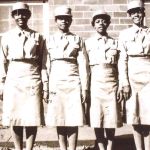
picture of me with my borrowed skirt and hat. I didn't have a jacket. It was
summer.
EE:
Summer of '43.
MF:
Yes, it was summer, because I went to Fort Shelby. It was Camp Shelby then.
EE:
Camp Shelby in North Carolina?
MF:
No, Hattiesburg, Mississippi. Took the train out of Fayetteville for
Hattiesburg, Mississippi. We changed trains in Atlanta.
EE:
And you were to be assigned to work the hospital in that place?
MF:
I was to be assigned to the 262nd Station Hospital that was being organized
at Camp Shelby in Hattiesburg for overseas duty. The chief nurse, the physical
therapist, about seven nurses, some doctors, I don't know how many, and our
enlisted personnel were there. We were there for several weeks. I can't remember
how long.
Then we left Hattiesburg, Mississippi, on the original train that was ever made.
The men lowered the windows to give us some air, and at night the doctors took
the seats apart so that we could have a place to sleep. There was no water on
the train, so when we'd go into small towns they would police off the station
area because a troop train was coming through—this was us and our little
hospital. The women—all of us—could go to the bathrooms and then the men could
go. This was the way it was coming from Hattiesburg, Mississippi, to New York
City.
We arrived in New York, and we were filthy. Filthy. We walked into this big
ladies' lounge, a restroom, I'm washing all this soot off my face, and here are
some others who had been at Fort Bragg and who had just arrived, too, coming up
to New York on air-conditioned trains. “What on earth?” They couldn't
get over the way we looked.
EE:
The long ride. New York was going to be your port of debarkation.
MF:
Yes. The enlisted men fed us on the way, and, of course, if we stopped at
any of these small towns and they could buy anything, they did.
EE:
Did you know where your orders were going to be after going to New York?
MF:
No.
EE:
They don't tell you until you're on the ship, do they?
MF:
I didn't know, and I didn't have any uniforms or anything else. I knew that
when we got to New York I would get the army uniform, which I did.
EE:
So you wore a uniform like the WAC uniform, or how is it different? Is there
any difference between that and the Army Nurse Corps uniform?
MF:
Well, the nurse corps uniform at that time was blue, but the nurse corps
then had to turn their uniforms in at port of embarkation, and they were issued
the ODs [olive drabs].
EE:
What's ODs? Overseas?
MF:
The jacket was sort of olive green, and the skirt was taupe or chino.
EE:
Overseas dress, OD?
MF:
Officer's dress.
EE:
So you're wearing sort of a brown—was it a khaki kind of thing or more dark
brown?
MF:
Well, going up to New York on the train, I wore slacks that had been issued.
EE:
Did you get on a troop ship to go to where you're headed?
MF:
We were in a convoy, and our ship was the E.B. Alexander. We were the only hospital on the ship, but there were several combat units on the ship also.
EE:
Did they have a red cross painted on your ship so that folks would know that
it was a hospital ship?
MF:
I guess they did. I don't know. We were in a convoy. I don't know what was
on the outside.
EE:
So how concerned were you about the safety on that convoy?
MF:
I wasn't the least bit concerned.
EE:
You were young, and this was exciting.
MF:
I was young, and I was going to war.
EE:
How did your folks feel about you—a dietitian, I assume they think, well,
she's going to have a nice career working in the hospital and not have to mess
with this war.
MF:
Of course, I had a brother in the army in the Pacific. I had a brother in
the navy, and my sister later joined the WAVES [Women Accepted for Volunteer
Emergency Service—Navy]. So, you know, they were very proud.
EE:
So you thought this was an opportunity for you to do something for the war,
too.
MF:
Well, I was just going because I had joined the army and they said, “Go,” and I was just going.
EE:
And I guess because you'd already been out of school, you were past
twenty-one. I guess you had to have your parents' signature if you were under
twenty-one.
MF:
Well, I didn't have to have the parents' signature.
EE:
So you never got any worries or second-guesses about having to go overseas
from your folks? You never heard that?
MF:
No.
EE:
Where did you end up going to?
MF:
We landed in Oran, [Algeria], and bivouacked there, and I was sent to Sidi Bel Abbès,
the home of the French Foreign Legion, to get some experience with an army
overseas hospital. It was a small station hospital. I was there, and I was doing
just as I had done in the civilian hospital. I didn't know anything else to do.
But they did not have a dietitian. It was a small hospital, and they were not to
have a dietitian for their complement I was there for probably three weeks.
Then I went to a larger station hospital in Oran; it was a 750-bed station
hospital, that had been there for a long time; they had several dietitians. I
was there for about two weeks. Then I went back out to our area where we were
bivouacked. We left Oran in September and went to Italy.
EE:
So your training was in North Africa, but that wasn't where you were
stationed.
MF:
Oh, no. While I was at Sidi Bel, the PT [physical therapist] was there, too,
and several nurses and some of the doctors. It was to familiarize all of us as
to overseas hospital set-up.
EE:
So you all went as a unit, the 262nd went as a unit to do all this training,
and you kind of went as a team?
MF:
No, we weren't as a unit at all. We were not as a unit until after they
found a place for us to set up the hospital in Italy.
EE:
And then you sort of reassembled. The same group that you had in Hattiesburg
came back together.
MF:
While in New York, nurses and doctors joined us coming up from South
Carolina and from other posts to give us the full complement.
EE:
What was the name of the base again where you were stationed? Bari, [Italy]?
MF:
No, no, no. Bari was an air force base. We went by ship from Oran to Italy
and landed in Pozzouli and bivouacked there for quite a while, slept on the
ground in a bombed out theater with no covers. It was cold and rainy. We just
waited until we were told our next move. The army did set up a shower tent for
us so that we could take showers and wash our hair in cold water. And every time
we got in the shower, the planes would come over and we'd have to stop and find
a safe place.
Then after a while we went as a unit into Naples to this big hospital that was
high, high on a hill. It was Mussolini's cure for TB [tuberculosis]. We were sitting there on
the curb, and we knew we wouldn't stay there because we were a small unit. We
could never take over that hospital. It happened to be what the 300th general
was to take over later.
And so then we went on to a town outside of Naples called Aversa, which was on
the highway to the front. We took over a military hospital. Each ward was a
separate paglioni [ward]. Again, rain and mud and cold. For the first weeks, we
lived in one of those paglionis, one of those wards, because we didn't have any
other place. Then eventually the nurses, dietitians, PT and Red Cross workers
moved into what had been the convent for the nuns, because the Sisters of
Charity had run that hospital. It was a military hospital.
EE:
So you were taking over an Italian military facilities?
MF:
Well, their facilities, and the nuns and patients moved across the street to
what had been the NP [mental] hospital. Then all of a sudden we had patients,
and we were not really ready. But we had patients.
EE:
How long were you stationed in Aversa?
MF:
About a year and a half.
EE:
So after all this shuttling to start off your career as an army dietitian,
that's a pretty long station, a year and a half.
MF:
Well, that's where our hospital was located. They were scheduled to go to
the Pacific. I didn't want to go, and so I asked for a transfer. As the war
progressed north, our patients were not the combat soldiers but the German POWs.
We had become a prisoner-of-war hospital. The prisoner-of-war stockade was down
the highway from our hospital one way, and there was a second on beyond the
hospital. Everything in Italy south of Rome had sort of quieted down. I just
wanted to be where there was more action. But of course I ended up going to the
17th General Hospital in Naples, which was very fine. It was a Harper Hospital
unit from Detroit. It was a big 3,000-bed hospital. It was good to be there.
EE:
So you were in Aversa from fall of '43 till springtime of '45.
MF:
Yes.
EE:
And then that's when you went to Harper in Naples. And then is that where
you were until the end of the time you spent in the service?
MF:
Yes.
EE:
So you were discharged from Italy.
MF:
Oh, no. I came home from Italy in—I think it was in September.
EE:
Right after VJ [Victory in Japan] Day.
MF:
Yes.
EE:
A typical day at Aversa, what was that like for you? Did you work seven-day
shifts there?
MF:
I worked seven days a week. All the nurses were having a week off to go to
R&R [rest and recuperation], but I was all by myself. There was no one to do my work. The only way was to train somebody. So I looked over all the enlisted personnel in the mess
department, and I picked out a young man I thought would be good. I set up the
menus, we had many special diets, and trained him. What was his name? I don't
know. They kidded him. They called him “Miss So-and-So,” whatever his
name was. He was very good. Because unless I had done that, I could not leave.
So I turned it over to him, and he took good care of it while I was away. I
can't remember his name, Vernon something.
EE:
You were in charge not only of planning the meals, but did you have to do
the procurement of the goods?
MF:
Well, no. See, the army was on sort of a standard rotating menu and standard
issue from the commissary depot, the quartermaster. Each hospital sort of
adjusted those menus to meet the needs of their patients and their personnel.
For example, when I went to the general hospital in Naples, they had a garden
down south of Naples and had a lot of fresh produce and salad items, and they
didn't really want C-ration meals. So we adjusted the menu so that we could use
the fresh produce. We could have light lunches of sandwiches and soups and
salads and things like that, and we'd have enough fresh produce to some days use
it for the enlisted personnel mess and then some days to use it for certain
wards of the patients. We could do that. That was our privilege to do that.
EE:
The people you were working with, when you first got to Aversa, how many
women were out there sleeping on the ground and were using the shower tents?
What was the percentage of women versus men?
MF:
Well, the men weren't there. That was in Pozzouli. I don't know where the
men were, but this was just us, just the nurses. I think we had probably forty
nurses with our unit, the chief nurse, the assistant chief nurse, then one
dietitian, and one physical therapist and three Red Cross workers.
EE:
That was about the ratio at most of the facilities?
MF:
I don't know. That was for a station hospital of our size. We were a 500-bed
station hospital.
EE:
I know stateside, the army specialized their hospitals, but obviously
dealing with a variety of battlefield injuries and traumas, I assume, they're
not specialized in the—
MF:
That's a little bit different than what we were doing. We didn't get into
any of that. That came along with the Korean War and the Vietnam War. The army
learned an awful lot, I think, about—
EE:
I know they had some stateside, and when you were there, you were handling
whatever, right?
MF:
Yes.
EE:
And then you say as the war moved, actually, from Italy, you were back from
the lines and became more of a prisoner-of-war hospital. So you switched from
having battlefield casualties to taking care of maybe some longer-term chronic
things.
MF:
Well, they were different and not necessarily “longer-term
chronic.”
EE:
I think one of the things that I'm impressed with dietitians about generally
is that they were acknowledged as the experts. Some women had difficulty dealing
with men because of the gender problems, but most dietitians I've talked to got
respect immediately because they knew the stuff, and everybody knew they knew
the stuff. So you didn't have that problem with some of them?
MF:
I had no problems like that.
EE:
Was your CO [commanding officer] a man?
MF:
Yes.
EE:
So it was a doctor who was in charge of the hospital?
MF:
Yes.
EE:
What did you end up doing for R&R the one week that you got to take off?
MF:
I went to Capri.
EE:
I've been there, yes. Was the bougainvillea in bloom?
MF:
Yes.
EE:
They're always in bloom in Capri.
MF:
You were there?
EE:
Did you go to the Cave of the Grotto?
MF:
Of course. I swam there.
EE:
You're braver than I am. I just remember having tortellini up on the
hillside.
MF:
When were you there?
EE:
Eighty-two.
MF:
Oh, goodness.
EE:
It was less threat of invasion or anything else then. [chuckling] When you arrived in '43, had the volcano already erupted?
MF:
No, it hadn't erupted. It erupted while we were in there, because it was
just bright daylight in Aversa with [Mount] Vesuvius erupted.
EE:
So it was nighttime when it erupted.
MF:
Yes. Because I have pictures of it the air force took. They're someplace. I
don't know where they are.
EE:
So were you in Aversa then?
MF:
I was in Aversa.
EE:
Which was across the bay, I guess.
MF:
Yes. We were north of Naples.
EE:
Did you feel the ground shake?
MF:
No. Just thought it was fantastic that this was going on.
EE:
In the middle of everything else.
MF:
Yes.
EE:
Elizabeth Shamburger talks about it when she was apparently at that general
hospital in Naples.
MF:
Well, they were high, high on a hill. The 300th General was at one of the
highest hills of Naples, and it was a big hospital. I don't know how many—I
think probably six or eight floors. So they had a perfect view of Vesuvius
because they also had a perfect view of the harbor. The 17th General was down
the hill from the 300th, it too had a perfect view of the Bay of Naples.
EE:
She talked about that to you and said that when she was stationed there, one
of the things she remembered was that the harbor was always full of ships, and
the ships would always leave at night because they'd have aircraft come in and
try to bomb that area. Did you have bombing, or was it cleared up by the time
that you were there?
MF:
By the time I was at the 17th, it was cleared out, and before that I was up
in the country. So we had our bombing, we had our night planes and everything
else.
EE:
But you didn't have antiaircraft fire going on, or did you?
MF:
Yes, we did when we were first there.
EE:
Did you feel in danger because of that?
EE:
Hold on a second. I'll get back, transcriber.
[recorder paused]
EE:
Nothing like being bombed to keep you together as a group, is there? [chuckles]
But that didn't last for that long while you were there?
MF:
Well, it was quite a while, because Cassino was right up the highway from
us, and the Germans were bombing the highway were bombing the highway that led
to Cassino all the time. Most of our patients came from Cassino. That was a
terrible, terrible battle.
EE:
This was late '43?
MF:
Probably into '44.
EE:
I think by spring of '44—when was Mussolini? Probably early '44,
Mussolini's out, isn't he?
MF:
I don't remember.
EE:
Do you remember hearing about that when you were there?
MF:
Oh, yes, I remember hearing about it.
EE:
Because I think after he committed suicide, I believe the townspeople
dragged him through the street or hung him up or something. It wasn't terribly
pleasant.
What was the hardest thing you had to do while you were in service, either
physically or emotionally?
MF:
The hardest thing?
EE:
Maybe two different things, physically hard versus emotionally hard.
MF:
For example?
EE:
The train ride up from Mississippi sounds like it was stressful. Was there
anything else physically stressful? You've got to carry your own gear. You've
got to do a lot of ad lib. You're out there in the boonies sleeping on the wood
and the ground.
MF:
Well, of course, that was all part of being in the army and going to war.
This was all part of it, and I wasn't the only one. There were several others.
Everybody else, you know, was going through the same thing in our unit.
EE:
So it wasn't unexpectedly hard for you, the physical part of it.
MF:
No.
EE:
What about the emotional part? What about being bombed? Was that emotionally
scary for you?
MF:
No, because you just got out of the way.
EE:
And you felt comfortable that that was going to be okay.
MF:
Yes.
EE:
So you never physically felt in danger while you were in the service?
MF:
No. If I did—now, you must remember that was about fifty or sixty years
ago. If I did, I don't remember it.
EE:
Well, it wasn't the overwhelming memory, certainly, from that time period.
MF:
No.
EE:
And again, you were in your early twenties.
MF:
Yes.
EE:
And at that age, nothing is ever life-or-death scary.
MF:
That's true. And you go along with whatever else is there.
EE:
And if you've got other people who are experiencing it with you, it's easier
to put a light-hearted edge to things.
MF:
Yes.
EE:
Are there some comical?-you mentioned a few things off the record that were
comical. Is there an embarrassing moment or something just funny that you
remember that happened from that time period? You know, a high stress job with
long hours, but is there some things that you remember that kind of
breakthrough?
MF:
I don't know.
EE:
Did the staff nurses, dietitians, physical therapists, did they socialize
with the patients, with the staff of the hospital? Did y'all have dances and
things like that?
MF:
Well, we didn't socialize with the patients. We had an officers' club.
EE:
In Naples or in Aversa?
MF:
Both places we had an officers' club. And there were officers' clubs in
Naples proper. The Orange Gardens was a great place to go to dance, and then the
PBS Club was another great place to go to dance. And, of course, there were all
these units along the way who we got to know and they got to know us, so we were
dating all the time and going to the Orange Gardens to dance, going to the PBS
Club to dance. You could be as social as you wanted to be.
EE:
This Orange Gardens, is that a place where they have—
MF:
It's no longer there, because when we went back—I went back in '70 with
another dietitian who was a friend of Shamburger's. We made a nostalgic revisit
to Italy. We rented a car in Rome, and we didn't really know how to get into
Rome to our hotel, so we hired a driver who drove us in. While I'm going into
the hotel to be sure our reservations are there, my friend is driving around
with the driver, finding out how to drive the car.
[End Tape 1, Side A—Begin Tape 1, Side B]
MF:
We got up early in the morning. Rome has about four or six rush hours, so we
decided to get ahead of the first rush hour. And it was so cold in that car. We
didn't know how to turn the heater on. So we stopped at a filling station on the
Autobahn and asked one of the men how to turn the heat on, and all he did was
push a button. So we got to Cassino about eight o'clock. Here are these two
American women in a car. The Italian workers were washing the floor in the
hotel, “What were we doing there?” We asked if they could fix
breakfast for us, and so they fixed breakfast for us.
Then we went on up to the top of the mountain and saw Monte Cassino. A
ninety-year-old padre took us on a tour of the whole place and showed us the
bombs that had been dropped but had not gone off while he was there. Then we
came down and stopped in Caserta and went all around Caserta and the palace
there, saw the gardens. We parked the car there. We had a horse and buggy to
take us around.
Then we came by Aversa, took a picture of the gate, came down to Naples, and
didn't know quite where to go. We knew where we were going to stay, but we were
at a stoplight so we asked the two fellows in the truck next to us how to get to
the Excelsior. They said, “Follow us.” So we followed them down, and
we got down to where our hotel was. They said, “Don't go in and leave your
car here. We'll watch it.” So we went into the hotel and everything was
fine. We came back, and gave them some cigarettes and again put the car in a
garage. We decided we would never be able to drive around Naples and find what
we wanted to see, so we hired a driver to drive us around and show us the places
we wanted. We saw the 300th General Hospital and couldn't go in there. Italian
hospitals have regulations about people visiting.
EE:
This was still being used as a hospital then?
MF:
Yes. It's a very important hospital. It's a cure for tuberculosis. We
couldn't get in. So then we came back down to where the 17th General Hospital
was. That was the Ides of March Hospital. We didn't even try to get in there. We
tried to find the Orange Gardens, but the Orange Gardens is no more.
EE:
Was it a private club, a military club?
MF:
Well, it had been a club, and it was just—
EE:
So it had been an Italian club?
MF:
It was an Italian club that the military had taken over, and it was just
great.We used to have dinner there and dancing and a beautiful view of the
harbor.
EE:
Sort of just a nice, open piazza where you could dance outside?
MF:
Yes, it was very beautiful.
EE:
Sounds nice. Is there some songs when you hear—
MF:
Oh, just Take Me Back to Sorrento, those songs, you know.
EE:
Did you ever think about the military a career? It doesn't sound like it.
MF:
No, I didn't.
EE:
One of the things I've heard from other dietitians is that—what was your
rank when you—
MF:
First lieutenant.
EE:
—is that once you got in, nobody gave you a promotion or gave you any
attention militarily.
MF:
I went in as a second lieutenant and then was promoted to first lieutenant.
In the Mediterranean theatre, none of the dietitians, even those who in civilian
life had held great positions, was more than a first lieutenant. Those who stayed
on in the army after we came home did make captain, but I did not stay in.
EE:
Were you asked to stay in?
MF:
No. I think people just—
EE:
They weren't looking to keep—
MF:
They weren't looking to keep us, no. I don't think so. That was not my
impression.
EE:
Are there some, when you think about that time, heroes or heroines that you
think of, people who were exemplary in what they did, how they served? In the
midst of it, it's hard to—you have a different view of things.
MF:
Yes.
EE:
Were you in Aversa or Naples when [Franklin D.] Roosevelt passed away?
MF:
I was in Naples.
EE:
How'd you hear about that? What did you think of it?
MF:
I heard about it—I was checking the officers' mess at breakfast time, and
we heard about it, and we just wondered what on earth will happen now. Here we
are in the middle of war, because it was still going on.
EE:
I don't know how it was in Italy. I've talked with some people who were in
France at the end of '44 when things are going very well, and then you have the
Battle of the Bulge, which for a few weeks makes it look like, oh, no, we might
actually lose a lot of territory and lose some men. But do you remember that
being a concern?
MF:
No, I don't. No.
EE:
So I guess probably by then you in Aversa were already talking about
switching over to be a POW hospital.
MF:
Well, I was not there. At that time, I was in—well, the Battle of the Bulge
was in December. I probably didn't even hear about it.
EE:
You talked about going back to Italy thirty years after the war.
MF:
We went back in '70.
EE:
When you were there after the battle for Cassino, did you go to that complex
while you were there, or did you ever see Monte Cassino?
MF:
Oh, yes. I had been there. The day they were bombing, the planes were coming
in over Cassino, a friend and I had driven up there. We were in our Class A
uniforms with the top down on the jeep, and we were told to get the hell out of
there.
EE:
They knew something was coming.
MF:
They knew something was coming.
EE:
And didn't bother to tell anybody in advance.
MF:
They could tell by the plate on the jeep that we were just sightseeing.
EE:
What did you think of Mrs. [Eleanor] Roosevelt?
MF:
I thought she was a marvelous person.
EE:
Who was in charge of—I don't believe, the way it was organized, there was
not a head of the army dietitians, or was there?
MF:
There was a Helen Burns, a Major Helen Burns, who was head of the army
dietitians, and she and Colonel Vogel, who was head of the physical therapists,
came overseas to all the hospitals, and this was when I was at the 17th General.
Because I think the 300th General had the dieticians entertain for Major Burns,
and we at the 17th had a dinner for Colonel Vogel and all the area physical
therapists.
EE:
The 17th was when you were in Aversa?
MF:
No. The 17th General was when I was in Naples. That's the Harper Hospital
unit.
EE:
Although they were the head of it, it sounds like you received your orders
from regular army folks as opposed to—Major Burns and her staff did not
assign—well, I guess they might have made the initial assignment of you to,
say, the 262nd?
MF:
I don't think so. I don't know how that was done, and I don't know when she
became the head of all the dietitians. I think the army surgeon general's office
made the assignment.
EE:
You felt no supervisory role from a dietitian. There was no authority?
MF:
No. We had our own little dietetic association in Naples for those
dietitians assigned to the area hospitals. Everything came from the army, from
the medical department of the army, assigning us to stateside hospital units. My
recollection.
EE:
Do you remember where you were when you heard about VE [Victory in Europe] Day, when the Germans
finally surrendered?
MF:
I certainly do. I was right there in Naples, and we had a big party. It was
May 8. But yes, our unit had a big—we were confined to quarters, and we had a
big field day with all kinds of relay races, pie-eating contests, all kinds of
games to celebrate. But we were right there on our own hospital grounds.
EE:
They confined you for fear that you might get wild and tear up the town?
MF:
That was the regulations. We were not allowed into town. They didn't know
what on earth would happen, I guess. So everybody had to stay within their own
unit.
EE:
But a very good day, a very happy, great day.
MF:
Oh, we had a great day.
EE:
Were you still in the service at VJ Day?
MF:
Yes.
EE:
In Naples still?
MF:
Yes, I was.
EE:
Somewhere staying close to your quarters.
MF:
Yes.
EE:
Throughout the course of one's life, one often meets many characters, people
that you may not know much about but that give a memorable vignette in your
life. Are there some military characters that stand out, folks even that you
worked with or served as patients or just individuals along the way that stand
out in your memory?
MF:
Probably so, but I can't—
EE:
We have not interviewed physical therapists in this program, but you all,
you physical therapists, dietitians, nurses, and Red Cross all housed together
where you were.
MF:
Yes.
EE:
Did anybody ever have any fear that we were not going to win the war, in
your memory? Everybody was confident that that was going to come about?
MF:
Of course. I think the people who were in the Pacific might have had some
thoughts, but not for us. Of course, particularly in Italy, because it was just
taken care of.
EE:
Italy was very fast. I've often heard from people who want to compare now to
then, and most of those folks who make the comparison didn't live then, but I've
heard it now from a number of contacts that, you know, differences that people
were genuinely patriotic across the board, they did not second-guess, they were
not cynical, they knew what had to be done and pulled together to do it.
MF:
It was an entirely different atmosphere than Vietnam, for example.
EE:
Think that was the change? The Vietnam experience changed it?
MF:
Well, you know, when people were in the military in Vietnam, they were sent
over there for a year and then they could come home. In World War II you were
there for the duration. Some fellows served two and three years. They were there
for a long time. And, of course, I had two years.
EE:
I know the folks in the WACs, their parents flew the flag back home in the
window with the star on it. Did yours get to put a star for a dietitian? Because
I know you said you had two brothers.
MF:
My mother had four of us. My parents had four of us in the service, and I
think they probably did have a flag with four stars. However, I don't remember
seeing it. It probably was taken down by the time I got home.
EE:
So they had a flag with four stars.
MF:
I know my father had a big picture of all of us in our uniforms, but I don't
remember the flag.
EE:
A question we ask everybody, although I'm prejudiced to say that I can give
you your answer. Do you feel that you contributed to the war effort?
MF:
Why, of course.
EE:
Good answer. That's what I would have told. Some of the folks we've
interviewed, and I guess it's because of the wide variety of jobs that women
were assigned, some did not feel as connected to the war effort and ultimately
what they did, because they may have been given jobs in an office environment
far away from seemed to be going on with the front-line stuff. I think
dietitians, especially those who went overseas, there's no question that they
were right there. When you're witnessing bombing and it's coming toward you, you
sort of feel a part of the war effort.
MF:
Well, that's true, and when you see—you know, some of these scenes you see
of tornadoes like the one just recently, it's the way it was when it had been
bombed. You know, it's just leveled.
EE:
One thing that Elizabeth Shamburger talked about, again, and she had no
context for it other than the fact that it stuck in her memory, was that they
would go on a Sunday to a graveyard to bury the folks who had died that week,
and it was a mass grave. The numbers were that big where she was in Naples.
MF:
Really?
EE:
Yes.
MF:
I know we had a military cemetery at the 17th, but it was like Arlington
[National Cemetery, Virginia] with the white crosses. It was not mass graves. I hadn't heard that about the 300th.
EE:
And it could be that this was enemy soldiers that were being buried, that
they didn't have the identification, but she said that apparently it did affect
her in a spiritual sense, too, witnessing all that death.
EE:
She also said that no bomb hit the hospital but Vesuvius dropped a big
boulder right in the middle of the freeway. [chuckles]
MF:
Yes.
EE:
You came back in the fall of '45. Where did you go?
MF:
I took an extended vacation. Then I went to the Veterans Administration [VA] in
Thomasville, Georgia, opened a hospital there. Shamburger was there. I convinced
her to join the VA, so she came down and joined the VA.
EE:
One of the things—I was just reading some stuff this morning about the VA
and the hospitals—is that the Second World War had more women veterans—they
didn't really have such a thing as women veterans before the Second World War,
and yet the VA hospital didn't always have facilities to treat women, did they?
MF:
That's right.
EE:
Did you have any women patients at that hospital?
MF:
No.
EE:
How long were you at Thomasville?
MF:
I think about two years.
EE:
I'll turn it off for a second for an editorial comment, and we'll be back.
[recorder paused]
EE:
You were at Thomasville, and then you left to go to Memphis.
MF:
When the hospital was closed, I went to a hospital in Memphis.
EE:
[unclear]
MF:
I don't know. But I went to Memphis, and then after a couple of years in
Memphis, I went to a VA hospital in Columbia, South Carolina, a year there, then
to a new VA hospital in Wilmington, Delaware, probably two years there, and then
to Durham, North Carolina. We always said we arrived with the last load of
bricks to open the new hospital. After three years there I left the VA and came
to Washington to work with the Navy Department.
EE:
At all these VA stops along the way, you had been doing basically the same
kind of work, being the hospital dietitian. At the navy you're probably not
being a hospital dietitian, or are you?
MF:
No, I'm not. I'm in the Office of Food Service Systems Command. It's an
office position. My particular area of responsibility was setting up training
guidelines for enlisted personnel assigned to food service billets.
EE:
This is a civil service position, which I guess you had been in since you'd
been in the VA.
MF:
Yes.
EE:
At Office of Food Service, are you traveling any or are you staying in
Washington the whole time?
MF:
Oh, no. With my job I traveled. I visited submarine bases and mine sweep
base in Charleston, visited the navy commissary men schools in San Diego, California, and
to the schools in Newport, Rhode Island.
EE:
How long did you stay in that post?
MF:
Well, I retired from the navy in 1974. With my military and the VA and navy,
I had thirty years, and one can retire at thirty years of service. I was
fifty-five years old.
EE:
Great. How do you think that your time in the military affected your later
life?
MF:
I think it helped. I think it helped me with my work with the Veterans
Administration and particularly with working with the navy.
EE:
It gave you a military imprimatur which gave you some legitimacy to speak
and to understand problems.
MF:
And to understand the military.
EE:
Because my guess would be, as a dietitian you did not free a man to fight,
but in the Office of Food Service Command you might have taken over from a man.
I don't know. Did you?
MF:
No.
EE:
Was it a new post?
MF:
What, Food Service Command? No, it was not. Our office was quite small.
There were only forty-six, and of the forty-six people, twelve were military and
the rest were civilians.
EE:
Any other dietitians?
MF:
Yes, there were other dietitians. It was sort of a headquarters for navy
food service.
EE:
Did you stay fairly plugged into the American Dietetics Association?
MF:
Yes, I did until I retired, well, until a couple years after I retired. Then
I knew I was never going to go back to work, so I resigned.
EE:
Is the kind of work you were doing the kind that required publication, or
did you do that kind of stuff with the—
MF:
Well, I ran a test kitchen and worked with standardized navy and marine
corps recipes. I made training films for the navy, enlisted cooks which
followed; basic meat cookery, poultry cookery, soups, whatever the recipe
section called for. I wrote the script and was technical advisor on location for
production of the films. Many of our enlisted personnel did not have the
opportunity to go to our schools, and these films provided training for them. We
were very concerned that the training films be professional, that they didn't
give the enlisted personnel a chance to laugh. Because, you know, if you get one
snicker or laugh, then you've lost their attention. The navy first started making movies, and then the air force, then after we had made about three, the army started making movies, too. So we soon had a wonderful library of training films.
EE:
The schools were largely held for those who would be cooks? I remember some
of the WAVES—was it WAVES—are the cooks in bakers' school?
MF:
Well, they probably did for the WAVES, but this was for navy male enlisted
personnel. There were schools in Newport, Rhode Island; Great Lakes, Illinois; San Diego, California; and then we set up a school in Charleston, South Carolina, for the personnel on mine sweepers and submarines.
EE:
And then this would be something that enlisted folks would go to after their
basic if they were going to specialize in being a ship's cook or something like
that?
MF:
Well, they were all cooks from a ship or from a shore station.
EE:
And I guess the goal was uniformity in procedures so that everybody—
MF:
They followed standardized recipes, and they followed the set procedures for
sanitation.
EE:
Were you starring in these films?
MF:
Oh, no. I just wrote the scripts, and I was the technical advisor on
location. This was the joy of making those films, because we would select a navy
enlisted man to be in the movie, and of course they loved it. I had a test
kitchen in Washington and a navy enlisted man assigned there. Whoever was in the
test kitchen was also going to be in the movie. We changed enlisted men every
year. So they all got an opportunity to be in the movie, and they loved it.
They'd go on location with us, and they did a very nice job. It was kind of fun.
EE:
So to some extent, you left the pay scale of the military, but you spent the
rest of your career basically in the military environment.
MF:
Yes.
EE:
You were one of those people that I might come interview even if you never
did have a uniform on simply because you've had a lot of experience with what
the service involved.
MF:
I had a lot of interesting things that I did.
EE:
I guess you retired before they put women on ships.
MF:
Yes.
EE:
How do you feel about that?
MF:
Well, I don't know. They had to make lots of changes in the ships, because,
you know, some of the ships were quite crowded, and they had to make a lot of
changes to make space for the women.
EE:
I know in December, I guess it was, for the first time we sent a woman
combat pilot on a mission in Iraq.
MF:
Yes.
EE:
Do you think women should be in combat? Are there certain positions where
women should be [unclear]
MF:
Oh, I don't know, but look, the Russians send them. I think probably the
Chinese send them.
EE:
Israelis.
MF:
And ours are so well trained. Why not?
EE:
So you don't have a problem that women would somehow “lose their
femininity” by—
MF:
Oh, no. No, no. I don't think so.
EE:
Do you think the military experience made you more of an independent person
than you would have been otherwise?
MF:
I think I've always been independent. My brothers tell me I've been too
independent. [chuckles]
EE:
But you wear that as a badge of honor, not a badge of shame. [chuckles]
MF:
I just listen to them.
EE:
One of the things that people have commented on when they look at the World
War II time, whether it's with Rosie the Riveter or Wanda the WAVE, whoever, is
that we had so many women going into jobs that had been traditionally done by
men or either in the work force working side by side with men, that it really
was the start of a social change much bigger than any one woman's experience.
MF:
Have you read Tom Brokaw's book [The Greatest Generation]?
EE:
My mom gave it to me as a present this spring. And that's sort of what we're
setting up to do with the Woman's College story, in telling one generation of
women's contributions. But did you feel part of a trailblazing kind of thing?
In retrospect, looking back, can you see that aspect of it?
MF:
No, I didn't. I think perhaps if I had had more years of experience behind
me, I probably would have, but I didn't have that many years behind me.
[Telephone interruption]
EE:
From '42 to '45 and then on to here, and then you've lived in this apartment
here, you say, the whole time since you've been in Washington?
MF:
I lived in an efficiency apartment for the first couple of years, and then I
moved to this one.
EE:
This is a beautiful part of town.
MF:
I just stay right here. Every time I've thought of moving to a newer, more
efficient apartment, into a new, more glamorous apartment or something like
that, and I'd be driving home from Wisconsin Avenue, and I'd think, “Oh, I
like this neighborhood.” So I'd stay.
EE:
A lot of things within not too far walking distance.
MF:
Well, my church is around the corner. On Connecticut Avenue there are very
good eating places. I drive, but if I need it, there's a bus that stops at the
front door.
EE:
I was parked in a parking space [unclear].
MF:
And then Metro is over here in the block, you know.
EE:
Right. The zoo's not too far.
MF:
The zoo's right up there. So it's really convenient.
EE:
I may be back up later this summer bringing my kids up to see the pandas.
Who knows?
MF:
How old are your kids?
EE:
One has just turned nine, and the other will turn five in a month.
MF:
Oh, they're a good age.
EE:
They're not old enough to be embarrassed with their parents. [chuckles]
MF:
But they're a good age to enjoy the zoo.
EE:
They are. They're old enough to really ask good questions.
I think people who have experienced the military through hospital experience
have a different military experience, but they know of the military experience
intimately that other folks who are not hospital employees have because they see
a lot of the consequences of it. Would you feel comfortable recommending women
to join the military?
MF:
Well, you know, there are so many advantages to the military now.
EE:
A lot more now, perhaps, than when you were in it.
MF:
I'm thinking now of the navy. They can get their education, and they have a
much better deal, and they're paid. I think it's a very good way. If a girl
cannot go to college any other way or doesn't have anything that she really
wants to do, why not join the military.
EE:
I think it's easier now in today's military to think of a career in the
military as a woman. I think, you know, at the time that y'all were in, most
folks were there for the duration, because that was really that it was always on
the radar screen.
MF:
It was for the duration. And then, you know, “What? You're with the
military?” you know.
EE:
But you did pick, in your subsequent jobs, jobs that your military
experience was an advantage. Some people have talked about that they really
didn't advertise the fact that they were in the military because they weren't
really sure how that would be taken.
MF:
Oh, it never bothered me.
EE:
We've gone over a lot, a lot of different places. Is there anything I have
not asked you about that, in thinking about today when I was coming up here,
that you want to share with us?
MF:
Oh, I don't think so. I'd be interested in that list, though, of all the
people.
EE:
Well, I have two lists, and one I'll have to send you because it's a list
that I pulled together for Vera Rackley about the dietitians that we know of.
MF:
I'd be curious.
EE:
And the other thing that I'll send when I send you back the tapes is a list
of everybody that we have interviewed this spring.
MF:
Because, you know, this is interesting, about the women—
EE:
And the one thing that we tried to get from everyone is if you've got a
picture of you in uniform—
MF:
Well, I want to show you some pictures. I'm not going to let you have them, because I'm going to give them to the Women's Memorial over here.
EE:
Okay. Just a copy of a few things would be nice, too. Transcriber, thank you.
[End of Interview]